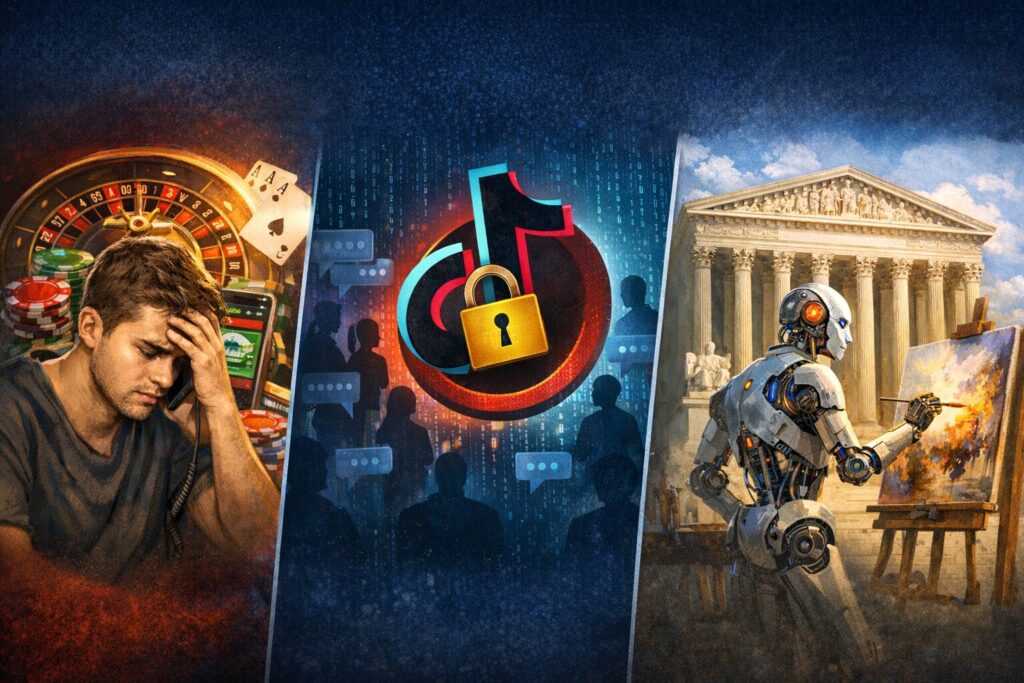
In this week’s GME3, a new Canadian Medical Association Journal study points to a sharp post-2022 spike in gambling-related calls to ConnexOntario, especially among young men. TikTok is openly declining to roll out end-to-end encryption for DMs so it can better police harm, a move child-safety groups are applauding and privacy advocates are questioning. And in the U.S., the Supreme Court has (for now) declined to hear a case determining whether fully AI-generated art can be copyrighted at all, leaving the current “human authorship required” line intact. Read the full stories below!
Gambling
The Other Kind of Call
A new study published in the Canadian Medical Association Journal finds a sharp rise in gambling-related contacts to ConnexOntario – Ontario’s free 24/7 mental health and addictions helpline – following key shifts in the province’s online gambling landscape. Researchers analyzed helpline contacts from January 2012 to September 2025 and observed increases after the launch of PlayOLG in January 2015, with a much larger jump after Ontario opened the market to private online gambling in April 2022.
Across the 13-year period, ConnexOntario received more than 745,700 total contacts, including roughly 37,000 related to gambling. The steepest change was among boys and young men aged 15–24: the mean monthly rate of gambling-related outreach per million people rose by 317% from the pre-PlayOLG period to the post-privatization period. Men aged 25–44 also saw a substantial increase (about 108%), while rates were described as stable before the policy changes.
Co-author Dr. Daniel Myran cautioned that increased awareness of the helpline may play a role, but argued the spike likely reflects more than just better visibility, pointing to increased gambling marketing after privatization and concerns about higher-risk products like micro-betting, which can encourage “loss chasing.” The study also noted a 239% increase in active player accounts per 100,000 Ontarians (15+) between April 2022 and August 2024.
Regulators argue that Ontario has strong ad rules and requires operators to monitor and intervene when harm is detected. Experts emphasized gambling-related harm as a public health issue, including links to mental health crises, self-harm, and broader impacts on families and communities.
Media
No Lock on the Tok
TikTok says it will not introduce end-to-end encryption (“E2EE”) for direct messages, arguing that doing so would make users – especially young people – less safe. E2EE is the highest-security mainstream messaging approach because only the sender and recipient can read messages, but critics say it also limits a platform’s ability to detect and investigate harmful or illegal activity occurring in private chats, and can reduce what law enforcement can access.
In comments to the BBC, TikTok said its position is deliberate. it wants safety teams (and police, where appropriate) to be able to review DMs in limited circumstances, such as when a user reports harmful behaviour or when there’s a valid law-enforcement request. TikTok adds that its DMs are still protected using “standard” encryption (similar to email) and that only authorized staff can access messages under defined conditions.
The decision also lands in a politically sensitive context: TikTok has faced long-running concerns about data security and its ownership by China-based ByteDance, and the BBC notes that its U.S. operations were separated from the global business earlier this year following U.S. legislative action. An analyst described TikTok’s move as strategically “savvy” for safety messaging, but warned it could clash with global privacy expectations and worsen perceptions tied to ownership.
Child-safety organizations, including the NSPCC and the Internet Watch Foundation, praised TikTok’s stance, arguing E2EE can hinder detection of child abuse and exploitation.
Entertainment
DABUS Gets Dismissed
The U.S. Supreme Court has declined to hear a case that would have squarely addressed whether AI-generated art can receive copyright protection under U.S. law, leaving in place lower-court rulings that copyright requires human authorship.
The case was brought by Stephen Thaler, a computer scientist from Missouri, who sought a copyright registration for a visual artwork titled “A Recent Entrance to Paradise.” Thaler said the image was created independently by his AI system, DABUS, and that there was no human author. The U.S. Copyright Office rejected his application in 2022, concluding that works must have a human creator to be eligible for copyright. A federal judge upheld that decision in 2023, calling human authorship a “bedrock requirement” of copyright, and the D.C. Circuit affirmed the ruling in 2025.
Thaler asked the Supreme Court to take the case, given the rapid growth of generative AI, arguing the issue is urgent and that leaving the Copyright Office’s standard in place could harm AI development and the creative industry during a critical period. The U.S. government urged the Court not to hear the appeal, contending that although the Copyright Act doesn’t define “author,” the statute’s structure and provisions indicate it refers to a human, not a machine.
The Copyright Office has separately rejected attempts by artists to copyright certain Midjourney-generated images, which do involve claims of human authorship with AI assistance, unlike Thaler’s position that the AI created the work entirely on its own.
GME Law is Jack Tadman, Daniel Trujillo, and Will Sarwer-Foner Androsoff. Jack’s practice has focused exclusively on gaming law since he was an articling student in 2010, acting for the usual players in the gaming and quasi-gaming space. Lindsay brings her experience as a negotiator and contracts attorney, specializing in commercial technology, SaaS services, and data privacy.
At our firm, we are enthusiastic about aiding players in the gaming space, including sports leagues, media companies, advertisers, and more. Our specialized knowledge in these industries allows us to provide tailored solutions to our clients’ unique legal needs. Reach out to us HERE or contact Jack directly at jack@gmelawyers.com if you want to learn more!
Check out some of our previous editions of the GME3 HERE and HERE, and be sure to follow us on LinkedIn to be notified of new posts, keep up to date with industry news, and more!