
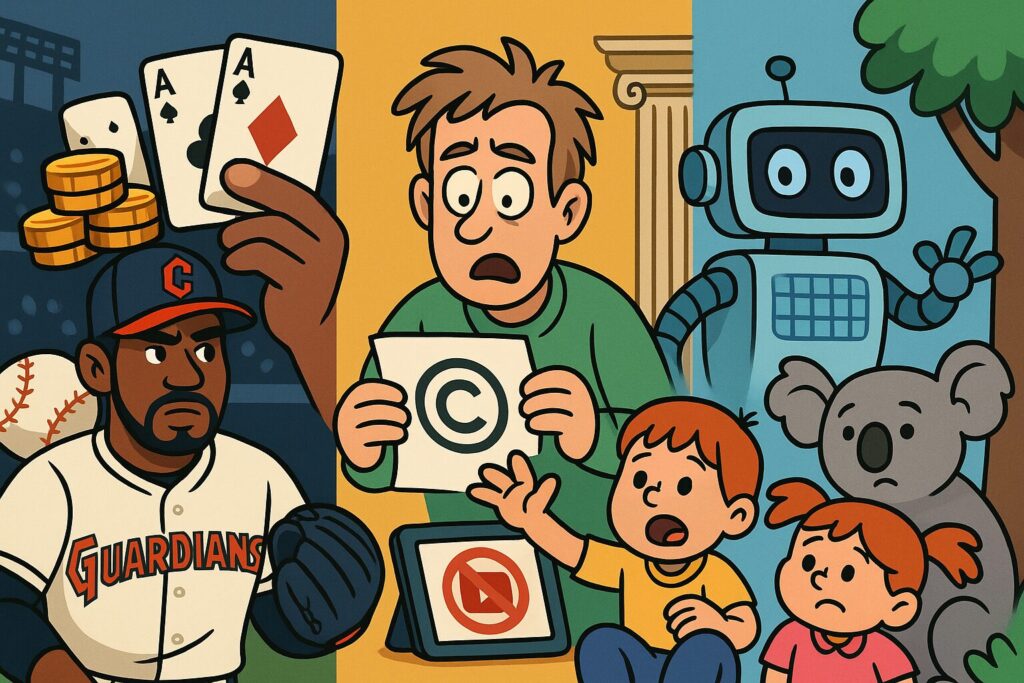
In this week’s GME3, Major League Baseball has benched star closer Emmanuel Clase amid a deepening betting probe. In Europe, creative workers are accusing the EU of failing to protect their rights under its landmark AI legislation. And in Australia, a dramatic policy reversal will see YouTube banned for under-16s, pitting regulators against tech giants once again. Read the full stories below!
Gambling
Pitch Imperfect
In the latest development in a growing scandal that began with fellow pitcher Luis L. Ortiz, Cleveland Guardians closer Emmanuel Clase has been placed on paid administrative leave by Major League Baseball amid an ongoing investigation into sports betting. The league’s decision, which sidelines Clase through at least August 31, comes as MLB continues to examine potential violations related to betting integrity.
While details remain scarce, the investigation reportedly centers on suspicious betting patterns involving Ortiz, including pitches that appeared intentionally off-target. ESPN reported in July that Ortiz is being scrutinized for potentially manipulating pitch outcomes. Now, Clase has been drawn into the probe, though no specific allegations against him have been publicly confirmed.
Under MLB Rule 21, players who bet on games in which they are involved face potential lifetime bans. The Guardians had been fielding trade inquiries for Clase but ultimately pulled back as they became aware of his possible involvement, wary of moving him amid uncertainty. Once placed on leave, he became ineligible to be traded.
The situation has rocked the Guardians’ clubhouse. Manager Stephen Vogt acknowledged the emotional toll, saying it “stinks” and that the team is grappling with the broader implications for the integrity of the sport. With both Ortiz and Clase now barred from team facilities, the Guardians are left without two key arms and with little clarity on what comes next.
President Chris Antonetti emphasized the organization’s commitment to due process but didn’t downplay the seriousness of the situation: “Two of our guys are being investigated. And that hurts.”
Media
The Write to Sue
A coalition of European creative industry groups is sounding the alarm over what they call inadequate protections for copyright under the European Union’s landmark AI Act. In a joint statement issued Wednesday, organizations representing writers, actors, musicians, journalists, and visual artists warned that the current implementation of the law fails to meaningfully safeguard intellectual property in the age of generative AI.
The AI Act, which takes effect August 2, requires developers of general-purpose AI models like ChatGPT and DALL·E to comply with EU copyright law and ensure “fair and appropriate” compensation for rightsholders. But the coalition argues that despite extensive consultations during the drafting process, the final version of the law leaves creators vulnerable to mass scraping of their work without consent or remuneration.
Calling the implementation a “missed opportunity,” the group noted that Europe’s creative sectors, which are responsible for nearly 7% of the EU’s GDP and employ close to 17 million people, are being “sold out” in favour of powerful AI developers. They’re urging the European Commission to revisit how the Act is being put into practice to fulfill its promise of protecting European cultural and economic interests.
This clash underscores growing global tensions over AI regulation. While EU officials tout the AI Act as a global benchmark, critics, including U.S. leaders, see it as overly restrictive. At a recent summit, U.S. Vice President JD Vance accused the EU of “tightening the screws” on American tech companies. Meanwhile, European creators say the screws aren’t tight enough where it really matters: on protecting the rights of those whose work is powering the AI boom.
Entertainment
No Wiggle Room Left
Australia has reversed course on an earlier promise and will now include YouTube in its sweeping social media ban for users under 16, a move that intensifies its global standoff with tech giants. The law, set to take effect in December, requires platforms like YouTube, TikTok, Instagram, and X to block underage users or face fines up to AU $50 million (~USD $32 million).
The decision comes amid growing concern about the harms children face online, including exposure to misogynistic content, dangerous challenges, and eating disorder material. A government-backed survey found that 37% of children reported seeing harmful content specifically on YouTube, prompting Australia’s eSafety Commission to recommend its inclusion in the ban. Communications Minister Anika Wells defended the move, stating that YouTube’s addictive design elements – like autoplay and algorithmic feeds – make it no different from other social platforms. “Our kids don’t stand a chance,” she told Parliament.
YouTube, owned by Google’s parent company Alphabet, criticized the move as a betrayal of prior commitments to treat the platform as educational, and is reportedly considering legal options. YouTube Kids, which lacks commenting and uploading features, is exempt from the ban.
Tech companies have pushed back, citing privacy concerns and arguing that the restrictions may limit support for vulnerable youth. YouTube recently announced AI-based age detection tools in the U.S. to enhance protections, but critics say enforcement and data collection pose their own risks.
Despite industry lobbying – including an appeal from children’s entertainers The Wiggles – the government insists the ban is necessary to combat escalating digital harms, even as it admits some kids will likely find workarounds.
GME Law is Jack Tadman, Lindsay Anderson, and Will Sarwer-Foner Androsoff. Jack’s practice has focused exclusively on gaming law since he was an articling student in 2010, acting for the usual players in the gaming and quasi-gaming space. Lindsay brings her experience as a negotiator and contracts attorney, specializing in commercial technology, SaaS services, and data privacy.
At our firm, we are enthusiastic about aiding players in the gaming space, including sports leagues, media companies, advertisers, and more. Our specialized knowledge in these industries allows us to provide tailored solutions to our clients’ unique legal needs. Reach out to us HERE or contact Jack directly at jack@gmelawyers.com if you want to learn more!
Check out some of our previous editions of the GME3 HERE and HERE, and be sure to follow us on LinkedIn to be notified of new posts, keep up to date with industry news, and more!