
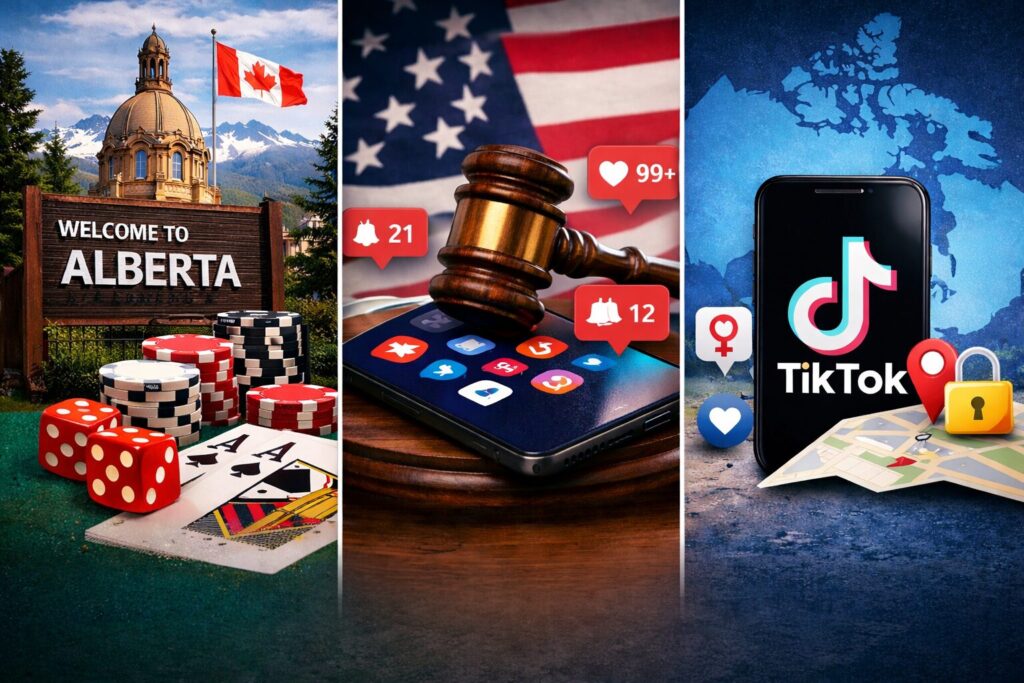
In this week’s GME3, an interview with Minister of Service Alberta and Red Tape Reduction Dale Nally sheds some light on Alberta’s plans for launching its regulated iGaming market in 2026. Meanwhile, in the U.S., TikTok has tapped out of a high-stakes “social media addiction” case at the last possible second, leaving Meta and Google to defend their algorithms in front of a jury. And back home, TikTok is facing fresh heat from Canada’s Privacy Commissioner over whether recent privacy policy updates – including more granular location tracking and references to sensitive data categories – will change what Canadian users are handing over when they scroll. Read the full stories below!
Gambling
Red Tape to Green Felt
The passage of the iGaming Alberta Act (Bill 48) in May 2025 created the legal foundation for a new Alberta iGaming Corporation (“AiGC”), and the recent release of Alberta Gaming, Liquor and Cannabis (“AGLC”) iGaming standards marks a major step toward allowing major operators – like FanDuel, BetMGM, DraftKings and bet365 – to enter a second Canadian province.
In an interview with Canadian Gaming Business, Minister of Service Alberta and Red Tape Reduction Dale Nally emphasized that Bill 48 was intentionally light on detailed rules to keep the system flexible over time: putting requirements in regulation (rather than legislation) makes it easier to adjust and “course-correct.” Like Ontario, Alberta will not cap the number of platforms, will split responsibilities between a regulator and a conduct-and-manage agency, and is drawing on “lessons learned” from nearly four years of Ontario market iteration.
Alberta’s standards also suggest a smoother pathway for Ontario-registered operators and suppliers: AGLC can treat registration in another jurisdiction as acceptable, potentially reducing friction for companies already vetted in Ontario. Alberta is also aiming to improve on Ontario in key areas, including a centralized self-exclusion system baked in to the Alberta market from day one.
Financially, Alberta’s nominal 20% tax rate comes after two deductions: 1% of gross gaming revenue for social responsibility initiatives (including addiction treatment) and 2% for First Nations communities. The province will also allow land-based casinos to host retail sportsbooks, creating additional revenue opportunities. Nally hinted the launch could be in the first half of the year, suggesting people “won’t be asking” about timing in the summer.
Media
A Jury of Your Followers
Canada’s privacy commissioner is examining whether TikTok’s new privacy policy updates change what data is collected from Canadian users, after the updates sparked concern about expanded tracking and the collection of sensitive information. The Office of the Privacy Commissioner of Canada (“OPC”) told Global News it’s unclear whether the changes apply in Canada, and that officials are in contact with TikTok to confirm what, if anything, has changed for Canadians.
The updated policy outlines the categories of information TikTok collects and appears to describe more detailed location-related data. It also includes language that, where permitted under local law, TikTok may collect sensitive information such as “sexual life or sexual orientation,” “status as transgender or nonbinary,” and “citizenship or immigration status” – phrasing that has drawn attention in media coverage.
The scrutiny comes amid broader uncertainty tied to TikTok’s U.S.-focused ownership transition, which reportedly triggered privacy policy changes for U.S. users and raised questions about whether similar updates could spill over into other markets.
This isn’t TikTok’s first Canadian privacy probe. In September 2025, the OPC and provincial privacy regulators released findings from a joint investigation concluding that TikTok did not adequately explain its data practices to teen and adult users and therefore did not obtain meaningful consent for collecting and using vast amounts of data, including sensitive data from younger users. TikTok indicated it had taken or committed to steps to improve, and regulators said they have continued working with the company on implementation.
Entertainment
Creepin’ It Real
TikTok has settled a lawsuit in California just hours before jury selection, avoiding participation in what’s being framed as a landmark “social media addiction” trial. The plaintiff, a 20-year-old woman identified as KGM, alleges that the design of social media products – particularly algorithms and engagement features – left her addicted and harmed her mental health. The settlement terms are confidential.
With TikTok and Snapchat now out (Snap settled last week), the case will proceed against other major platforms, including Meta (Instagram/Facebook) and Google (YouTube). The defendants argue the evidence doesn’t prove they caused harms such as depression or eating disorders, and they are expected to blame alleged harms on third-party users and content.
A key legal issue is that this case targets platform design choices – algorithms, notifications, and other features – rather than user-generated posts, potentially limiting the traditional protection companies cite under Section 230 of the Communications Decency Act. Commentators note the stakes are significant: losing could expose platforms to major liability, but proving causation between product design and specific injuries may be difficult.
Jurors are expected to see internal company documents, and the trial could force public disclosure of information that platforms have tried to keep private. A major anticipated witness is Meta CEO Mark Zuckerberg, who is slated to testify early; he has previously told US senators that existing science does not show a causal link between social media and worse youth mental health outcomes, while also apologizing to victims’ families in a 2024 hearing.
GME Law is Jack Tadman, Daniel Trujillo, and Will Sarwer-Foner Androsoff. Jack’s practice has focused exclusively on gaming law since he was an articling student in 2010, acting for the usual players in the gaming and quasi-gaming space. Lindsay brings her experience as a negotiator and contracts attorney, specializing in commercial technology, SaaS services, and data privacy.
At our firm, we are enthusiastic about aiding players in the gaming space, including sports leagues, media companies, advertisers, and more. Our specialized knowledge in these industries allows us to provide tailored solutions to our clients’ unique legal needs. Reach out to us HERE or contact Jack directly at jack@gmelawyers.com if you want to learn more!
Check out some of our previous editions of the GME3 HERE and HERE, and be sure to follow us on LinkedIn to be notified of new posts, keep up to date with industry news, and more!