
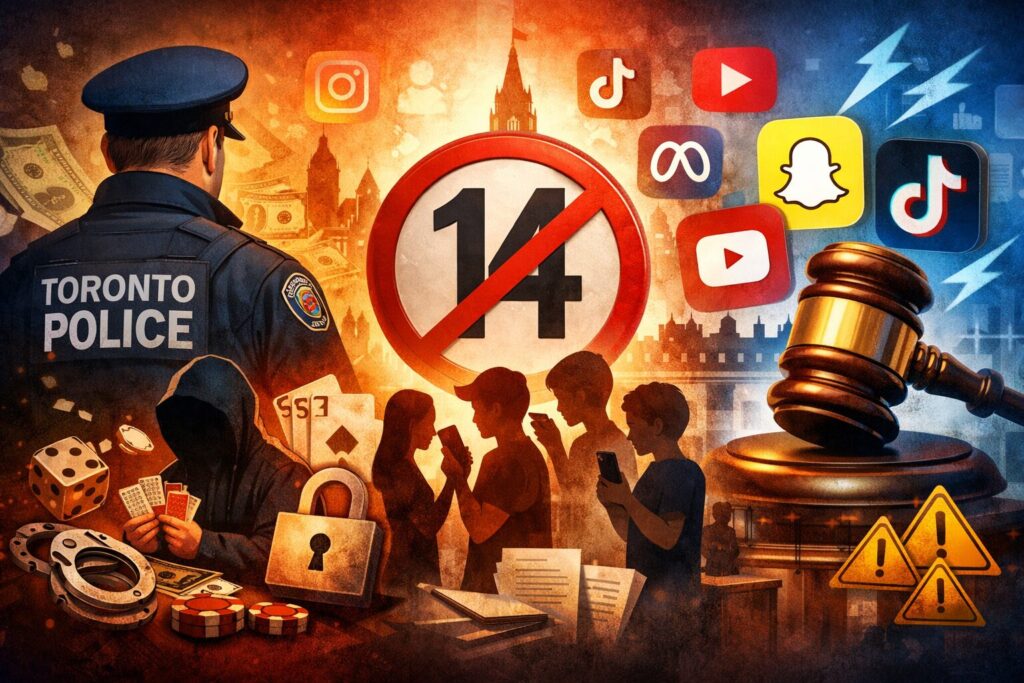
In this week’s GME3, York Regional Police say a retired Toronto officer is facing charges tied to an alleged credit-based illegal gambling ring where debts were allegedly collected with threats and violence; Ottawa is reportedly weighing a tougher age gate as part of a revamped online harms bill, including a possible social-media ban for kids under 14 (and the question of who would enforce it); and in the U.S., Snap has quietly stepped out of a looming “tech addiction” trial by settling, while Meta, TikTok, and YouTube stay in the hot seat. Read the full stories below!
Gambling
Cash Out and Cuffs On
The AGCO’s recent $350,000 penalty against FanDuel – tied to several weeks of suspicious betting on Czech table tennis in 2024 – is one of the largest fines issued to an online gaming operator since Ontario’s regulated market launched in April 2022, matching the fine previously imposed on Great Canadian Entertainment. More importantly, it is the first AGCO penalty for a sports integrity failure, rather than the more typical issues like advertising violations or player protection shortcomings.
AGCO officials framed the decision as part of a broader push to keep Ontario sportsbooks from being exploited by insiders or match-fixers and to support the global fight against match-fixing. The regulator has shown heightened sensitivity to integrity risks in recent years, including previous actions such as banning betting on UFC events in 2022 over insider-betting concerns and restricting markets on WBA events in 2024. Scrutiny has intensified across North America amid high-profile scandals, including the Jontay Porter case and other incidents affecting major leagues.
The AGCO emphasized that sportsbooks are the first line of defence, with obligations to monitor wagering in real time, work with independent integrity monitors, and promptly report suspicious activity – areas where the regulator’s dissatisfaction with FanDuel centred. FanDuel, however, maintained that its monitoring program helped it proactively identify, investigate, and report the activity. The OPP’s Investigation and Enforcement Bureau has launched a criminal investigation, and FanDuel can appeal the fine until late January.
Media
A Minor Ban
Canadian federal officials are considering adding a social-media ban for children under 14 to the government’s forthcoming online harms bill, according to three unnamed sources cited by The Globe and Mail. The idea is partly influenced by Australia’s under-16 social-media ban, which took effect in December and has prompted interest in similar measures in Canada and the U.K. While many platforms already set a minimum age of 13, the sources note children often circumvent that rule, and the proposed policy would raise the threshold to 14 pending cabinet approval.
Officials are also debating whether a new regulator would be needed to enforce a ban, including monitoring compliance and issuing penalties. The online harms bill is expected within months and would replace Bill C-63, which died when Parliament was dissolved last year. A separate privacy-law update, expected from AI Minister Evan Solomon, may include new protections to prevent targeted marketing to youth under 18.
Child-safety advocates argue that weak online controls leave kids vulnerable to grooming, scams, and coercive harassment. New data from the Canadian Centre for Child Protection indicates reports of extreme online violence (often targeting girls) have risen, with many reports occurring in the past year and involving threats to distribute intimate images to coerce risky or self-harm behaviour.
Experts and health leaders broadly support delaying social-media access but warn a ban alone won’t fix underlying platform harms. McGill’s Taylor Owen and SickKids’ Charlotte Moore Hepburn stress that without an independent regulator and stronger platform guardrails, teens could “age into” an unsafe ecosystem. Meanwhile, major platforms are lobbying for enforcement: Meta has promoted age verification at the app-store level, while Google criticizes that approach as shifting responsibility and creating privacy risks. The bill is expected to be led in Parliament by Canadian Identity Minister Marc Miller.
Entertainment
Snap Judgment
Snapchat’s parent company, Snap, has settled a U.S. civil lawsuit in California just before it was set to go to trial, though other major tech companies named in the same litigation – including Meta (Instagram), ByteDance (TikTok), and Alphabet (YouTube) – have not settled and still face trial.
The case is part of a wave of “tech addiction” lawsuits brought on behalf of young people, including a plaintiff identified as K.G.M., a 19-year-old woman who alleges she developed mental health problems after becoming addicted to social media apps. Snap CEO Evan Spiegel had been expected to testify before the settlement was reached.
This proceeding is the first of three “bellwether” trials intended to test key arguments across thousands of similar lawsuits that have been consolidated. A Los Angeles judge previously ruled that the platforms’ design features, rather than just third-party user content, could potentially be responsible for harm. That distinction is significant because tech companies have often relied on Section 230 of the U.S. Communications Decency Act to argue they aren’t legally liable for content posted by users.
Even with Snap settling this particular case, it remains a defendant in the other two bellwether matters. Jury selection for the first bellwether trial is still scheduled to begin on 27 January. Plaintiff-side lawyers have suggested the litigation could lead to major financial exposure (potentially billions in damages), force changes to platform design, and spur new U.S. regulations around how social-media companies interact with minors, drawing comparisons to past public-health litigation against tobacco and opioid manufacturers.
GME Law is Jack Tadman, Daniel Trujillo, and Will Sarwer-Foner Androsoff. Jack’s practice has focused exclusively on gaming law since he was an articling student in 2010, acting for the usual players in the gaming and quasi-gaming space. Lindsay brings her experience as a negotiator and contracts attorney, specializing in commercial technology, SaaS services, and data privacy.
At our firm, we are enthusiastic about aiding players in the gaming space, including sports leagues, media companies, advertisers, and more. Our specialized knowledge in these industries allows us to provide tailored solutions to our clients’ unique legal needs. Reach out to us HERE or contact Jack directly at jack@gmelawyers.com if you want to learn more!
Check out some of our previous editions of the GME3 HERE and HERE, and be sure to follow us on LinkedIn to be notified of new posts, keep up to date with industry news, and more!