
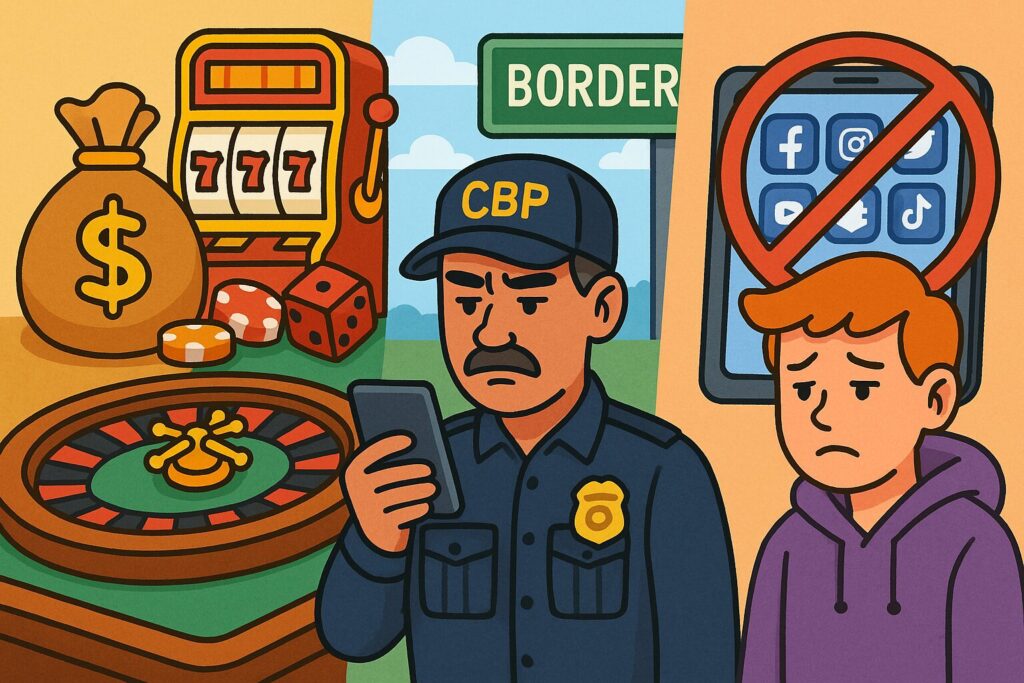
In this week’s GME3, the topic of First Nations gaming authority has returned to the Canadian Senate in the form of Bill S-241, a new proposal could make it mandatory for many short-term visitors entering the U.S. to share up to five years of social media activity, and in the wake of Australia’s under-16 social media ban going into effect Canadian experts question if a similar approach could be taken here. Read the full stories below!
Gambling
First Nations’ Second Try
Senator Scott Tannas’ Bill S-241 has returned the issue of First Nations’ authority over gaming to the Senate. The bill would amend the Criminal Code to affirm that a First Nation’s governing body has exclusive authority to conduct, manage, and/or license gaming on its reserve lands. It would also amend the Indian Act to allow First Nations to regulate such gaming themselves. Tannas framed this as aligning First Nations jurisdiction with the powers provinces already hold in their own territories.
Under S-241, a First Nation would need to notify the federal and relevant provincial governments of its intention to run gaming “from or within” its reserve, but would not need their approval. The bill is a revised version of S-268 (introduced in 2023), which stalled after committee review. Tannas said the earlier committee process generated meaningful testimony and prompted significant First Nations support, but he emphasized there is still more work to be done at committee.
Since the earlier version, 15 First Nations have publicly announced support for the legislation. Notably, the Mohawk Council of Kahnawà:ke, which had opposed S-268, now supports S-241 following further consultations. Tannas also acknowledged that provincial buy-in matters and said he has begun discussions with some premiers. He suggested provinces may worry about lost revenues but argued that breaking provincial monopoly control is central to “real economic reconciliation” and would give Indigenous governments meaningful leverage.
Even if passed, Bill S-241 would only open the door. First Nations could still choose to negotiate with provinces or join a self-regulating Indigenous authority.
Media
Followed At the Border
A new U.S. Customs and Border Protection proposal could soon make social media disclosure mandatory for many short-term visitors entering the United States under the Visa Waiver Program. The change would apply to travellers who use the Electronic System for Travel Authorization (ESTA), a pre-clearance online application that currently collects basic biographical details, passport information, and questions about past criminal history for visits of up to 90 days without a visa.
Social media details were added to ESTA in 2016 as an optional field, with current guidance indicating that applicants can leave it blank without negative inference. The new proposal would change that by requiring applicants to provide their social media history from the prior five years. In addition, the draft would expand the scope of other data requested, including “high-value” identifiers such as phone numbers and email addresses used over the last five years. It would also widen the collection of information about close family members, reportedly including names, birth dates, birthplaces, residences, and phone numbers over the same period.
The proposal is open for public comment through February 9, 2026. While the practical impact remains unclear, the change appears to sit within a broader Trump administration effort to tighten immigration screening across both legal and illegal routes. The administration has also increased scrutiny of social media in other contexts, including student visas, where applicants may be asked to set profiles to public and where a lack of online presence could potentially be viewed unfavourably.
Entertainment
No Timeline For Teens
Australia’s new youth social media law has now come into effect, barring people under 16 from holding accounts on major platforms including Facebook, Instagram, Threads, X, YouTube, Snapchat, Reddit, Kick, Twitch and TikTok. As of Wednesday, those companies were expected to remove underage accounts and implement measures to stop new ones from being created.
But a Canadian digital rights expert, Matt Hatfield of Vancouver-based non-profit Open Media, argues that a similar blanket ban is unlikely to work well in Canada. He describes Australia’s approach as a “blunt tool” for a complex set of youth harms. While it might reduce some risks, he warns it could produce unintended consequences and fail to address other problems.
Hatfield doubts the policy will recreate anything like a pre-internet environment for teens. Instead, he expects young people to shift to other online spaces, such as private messaging apps or platforms like Discord. That could mean issues like online bullying simply migrate elsewhere rather than disappear.
He also raises a safety concern: if many teens inevitably find ways around the ban, they may be less willing to seek adult help if something goes wrong while they are using platforms illegally.
Given these uncertainties, Hatfield recommends that Canada avoid rushing to copy Australia and instead wait for evidence of how the law plays out there. He suggests more targeted and “nuanced” solutions, such as holding platforms to stronger youth safety standards – especially around algorithms and the content shown to young users – rather than imposing an outright ban.
GME Law is Jack Tadman, Daniel Trujillo, and Will Sarwer-Foner Androsoff. Jack’s practice has focused exclusively on gaming law since he was an articling student in 2010, acting for the usual players in the gaming and quasi-gaming space. Lindsay brings her experience as a negotiator and contracts attorney, specializing in commercial technology, SaaS services, and data privacy.
At our firm, we are enthusiastic about aiding players in the gaming space, including sports leagues, media companies, advertisers, and more. Our specialized knowledge in these industries allows us to provide tailored solutions to our clients’ unique legal needs. Reach out to us HERE or contact Jack directly at jack@gmelawyers.com if you want to learn more!
Check out some of our previous editions of the GME3 HERE and HERE, and be sure to follow us on LinkedIn to be notified of new posts, keep up to date with industry news, and more!