
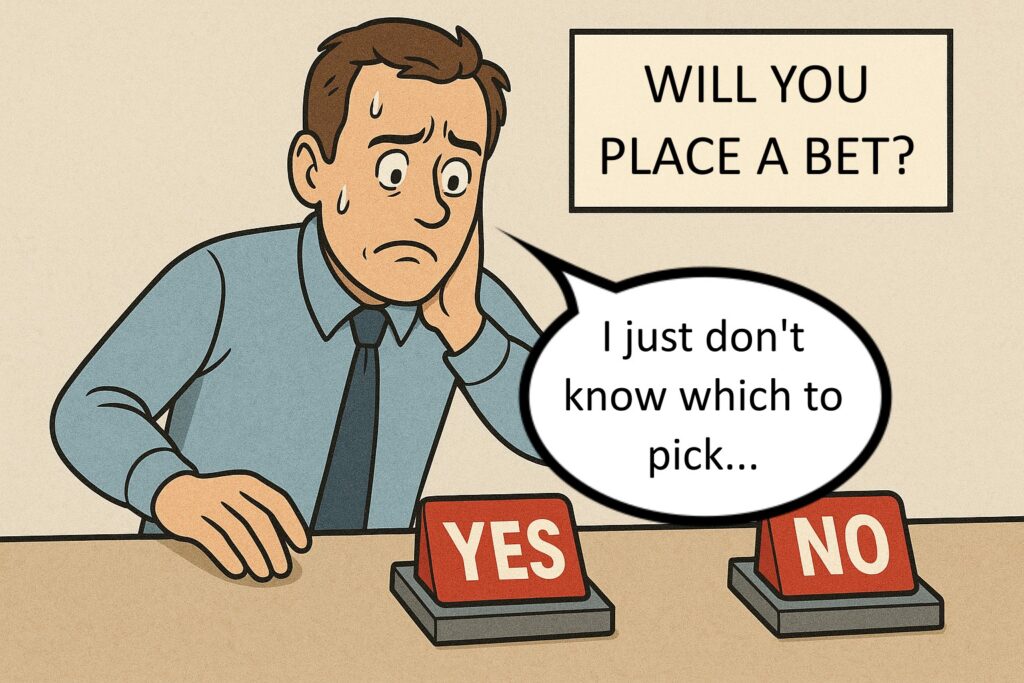
Prediction markets have had a strange couple of weeks in the spotlight, and the recent controversy related to the popular game Roblox hasn’t helped. On a recent appearance on the Hard Fork podcast, Roblox CEO David Baszucki suggested that adding prediction markets for kids inside the platform would be a “brilliant idea,” as long as it could be done in an “educational way that’s legal.” He floated a game like “Dress to Impress Predictor,” where kids would forecast which avatar wins a fashion contest and stake something of value on the outcome, but with no monetary prizes or “free Robux.”
The reaction was harsh. Critics pointed out that Roblox is already under heavy scrutiny over child safety, alleged exploitation, and even investigations and lawsuits related to predators on the platform. Pitching “educational” betting mechanics to a mostly under-18 audience, at the same time that regulators and prosecutors are circling, struck many as tone-deaf. But the idea itself is not coming out of nowhere. From crypto-native projects like Polymarket to CFTC-regulated platforms like Kalshi, prediction markets are moving steadily from the fringes into the financial and gaming mainstream.
The Marketplace of Predictions
At a basic level, a prediction market is simple. You buy and sell contracts that pay a fixed amount if some future event happens and zero if it does not. As an example, a “Yes” share that pays one dollar if the Toronto Maple Leafs win the Cup might trade at 0.27. In plain language, the market is saying there is a 27% chance of that outcome occurring. Traders can buy, sell, hedge, or arbitrage these contracts as new information comes in.
In practice, platforms list contracts on all kinds of outcomes: elections, economics, sports, and even weather and policy decisions. Kalshi in the United States, for example, has listed markets on inflation, interest rates, and sports outcomes, while positioning itself as a fully regulated “event contract” exchange overseen by the Commodity Futures Trading Commission (“CFTC”). Crypto-native operators like Polymarket took a different route, using stablecoins and blockchain settlement to allow global users to trade “Yes/No” outcomes on everything from politics to pop culture.
Prediction markets aggregate information across thousands of participants into a single, continuously updated probability. Because traders have money at stake, they have an incentive to be honest and informed. From a regulator’s perspective, the resemblance to gambling is hard to ignore. Users are still staking real value on uncertain future events, with the risk of loss and the potential for addiction, fraud, and unfair dealing.
Trouble Down (Not That Far) Under
The United States has tried to create space for these products through federal derivatives law, but the path forward has been messy. Kalshi is the clearest case study. It is registered as a designated contract market with the CFTC and markets itself as a compliant U.S. exchange where customers can trade on future events. Yet it is now the target of a class action in New York that accuses Kalshi and its main market maker of operating unlicensed sports betting, misleading consumers about who they are really trading against, and giving institutional market makers special advantages on fees, limits, and risk. The plaintiffs argue that retail users believe they are trading against other individuals, when in reality they are often facing a sophisticated firm on the other side of the trade.
Representatives from Kalshi have dismissed the lawsuit as “meritless fiction” and argue that the claims misunderstand how modern derivatives exchanges and market makers actually work. At the same time, several state regulators have taken the position that, whatever the CFTC thinks, offering retail contracts on sports and similar events is unlicensed gambling under state law. Nevada recently won a key ruling that determined Kalshi is subject to state gambling rules, rather than the federal laws that apply to a derivatives platform. Massachusetts has filed its own suit, and gaming regulators or attorneys general in other states have issued cease-and-desist letters or launched investigations.
This is the core U.S. tension. At the federal level, prediction markets can be framed as financial instruments that belong under derivatives law. At the state level, many regulators and politicians see prediction markets as gambling under another name. As more businesses, like Robinhood, big sportsbooks, and even crypto exchanges, either launch or partner with prediction markets, the pressure to draw hard lines is only increasing.
Ontario Draws the Line
That’s the situation below the border, but what about Ontario? Here, the answer for retail users is, for now, very simple: prediction markets are a no-go. In 2017, the Ontario Securities Commission (“OSC”) adopted Multilateral Instrument 91-102, or the Prohibition of Binary Options. The instrument explicitly bans advertising, offering, selling, or otherwise trading binary options with individuals in Ontario, with a focus on short-term all-or-nothing contracts that had become notorious vehicles for fraud.
Binary options are defined broadly and catch exactly the sort of “Yes/No” structure that prediction markets use, especially where the contract expires in less than 30 days. Ontario regulators saw these products as extremely high risk for retail investors and as a magnet for offshore platforms promising huge returns with little disclosure or oversight. Instead of trying to regulate that space, they slammed the door.
Polymarket found this out the hard way, as we’ve written about previously. Between 2020 and 2023, Ontario residents were able to access Polymarket and trade event contracts through its online platform. The OSC took the view that these contracts were binary options captured by MI 91-102 and that the platform was operating in breach of the prohibition.
In April 2025, a settlement was approved with Polymarket’s operators, Blockratize Inc. and Adventure One QSS Inc., under which the companies agreed to a two-year ban on participating in Ontario’s capital markets and on acting as registrants or promoters, subject to narrow exceptions so Ontario users could close out their positions. They also agreed to pay a CAD $200,000 administrative penalty, CAD $25,000 in costs, and to disgorge roughly USD $23,000 in revenue earned from Ontario users. Most importantly, they committed to block Ontario residents from the platform permanently and not to offer new binary options here in future.
The lesson is straightforward. You can call a product a “prediction market,” an “information market,” or anything else. If it looks like a short-term, all-or-nothing event contract to the OSC, it is going to be treated as a banned binary option. There is no equivalent of Kalshi’s federally regulated derivatives status, and there is no appetite, at least so far, to open a retail exception for small-stakes event contracts. For Ontario consumers, that means Polymarket-style public prediction markets are effectively unavailable, unless there’s a significant policy shift.
What the Blox?
Which brings us back to Roblox. Baszucki’s suggestion rests on the idea that prediction markets can be fun and educational, particularly if you strip out real money and obvious prizes. However, regulators are unlikely to stop at the label and will probably ask questions like whether these mechanics normalize gambling-like behaviour for minors, whether the in-game currency or items at stake have any cash-equivalent value, and whether young users are being nudged into risk-taking habits that can later show up in real-money environments. An in-game prediction market will be a hard sell for a platform already facing allegations that it has not done enough to address grooming, scams, and unsafe third-party experiences.
The broader theme across jurisdictions is that prediction markets sit on an uncomfortable line, halfway between finance and gambling. In the United States, that discomfort shows up as a jurisdictional tug-of-war between the CFTC and state gaming regulators, with class actions and constitutional arguments along the way. In Ontario, it shows up as a hard line: if your event contract looks like a binary option, you’re out of luck.
Prediction markets can be powerful tools for aggregating information and teaching people to reason about risk. But the Polymarket settlement in Ontario and the growing litigation around Kalshi in the United States are reminders that once you attach real value to those probabilities, you are no longer in a thought experiment. For now, the intersection where Roblox, Wall Street, and the casino floor meet is under heavy scrutiny and, at least in Ontario, clearly not feasible.