
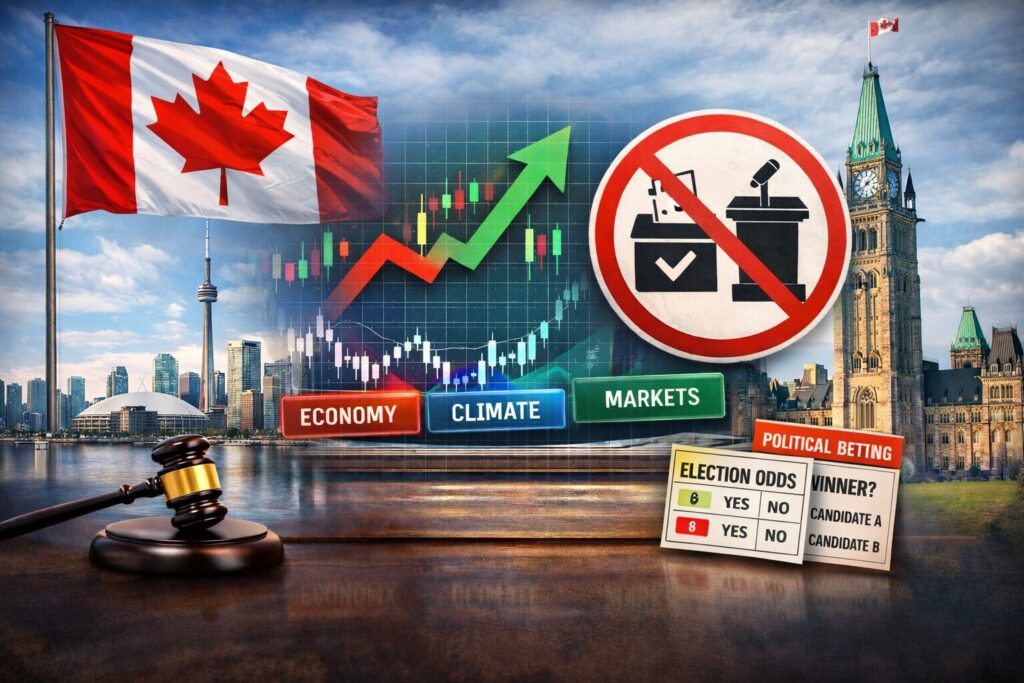
Recent developments in Canada suggest regulators are beginning to change their views around prediction markets. A March 26 bulletin from the Canadian Investment Regulatory Organization (“CIRO”) on event contracts, together with the approval allowing Wealthsimple and Interactive Brokers Canada to facilitate trading in a limited subsection of those products, indicates that Canada is prepared to permit some event-based contracts, but only on narrow and carefully controlled terms. Certain topics, such as predictions on the outcome of sporting events (a massive industry in the U.S.), will not be permitted in Canada.
Another significant change in how Canada is approaching these products is the absence of political forecasting. In the U.S., “betting” on politics through platforms like Polymarket and Kalshi has become very popular, with one study claiming that ~$7.2 billion of 2025’s total trading volume came from political markets alone. CIRO, on the other hand, has expressly excluded politics from the types of markets that will be permitted in Canada – an approach that has been mirrored in the upcoming launch of the regulated iGaming market in Alberta (now scheduled to go live by July 13, 2026).
This article will break down the consequences of CIRO’s March decision, explore why politics will be excluded by examining the impact that political markets have had in the U.S., and look at how Alberta has preemptively blocked political bets of any kind.
CIRO-ing in on a Canadian Product
CIRO has identified a limited subset of event contracts that may be offered in Canada (subject to terms and conditions imposed in consultation with the Canadian Securities Administrators). Under Appendix A of the March 26 bulletin, dealer members’ offerings will be limited to contracts based on economic forecasts, environmental forecasts, and financial indicators. CIRO’s own examples include markets around sovereign debt, inflation, central bank reserve rates, labour markets, housing, climate indicators, and certain forecast contracts tied to S&P 500 futures. This list suggests that for this initial launch, CIRO is only prepared to tolerate contracts that can – at least plausibly – be characterized as adjacent to macroeconomic or market exposure, rather than as general retail wagering products.
CIRO has also imposed structural limitations on how these contracts can be formed. Dealer members may only facilitate trading in permitted event contracts with a term to maturity of 30 days or longer. CIRO has further stated that issuing a new threshold for an event contract constitutes an entirely new contract, meaning the 30-day minimum must still be satisfied. This will hopefully push the Canadian product away from rapid-cycle, yes-or-no speculation and toward something more readily defensible within a securities framework.
Politics, Schmolitics’
CIRO has identified a limited subset of event contracts that may be offered in Canada (subject to terms and conditions imposed in consultation with the Canadian Securities Administrators). Under Appendix A of the March 26 bulletin, dealer members’ offerings will be limited to contracts based on economic forecasts, environmental forecasts, and financial indicators. CIRO’s own examples include markets around sovereign debt, inflation, central bank reserve rates, labour markets, housing, climate indicators, and certain forecast contracts tied to S&P 500 futures. This list suggests that for this initial launch, CIRO is only prepared to tolerate contracts that can – at least plausibly – be characterized as adjacent to macroeconomic or market exposure, rather than as general retail wagering products.
CIRO has also imposed structural limitations on how these contracts can be formed. Dealer members may only facilitate trading in permitted event contracts with a term to maturity of 30 days or longer. CIRO has further stated that issuing a new threshold for an event contract constitutes an entirely new contract, meaning the 30-day minimum must still be satisfied. This will hopefully push the Canadian product away from rapid-cycle, yes-or-no speculation and toward something more readily defensible within a securities framework.
Trouble Down South
The American experience helps explain why CIRO’s framework is so narrow. In the United States, prediction markets have expanded well beyond macroeconomic or financial forecasting into sports, politics, and entertainment. That expansion has produced increasingly direct conflict between platforms offering event contracts and state gambling regulators who regard (at least some of) those offerings as unlicensed betting.
For instance, this past March, a Nevada judge temporarily blocked Kalshi from offering contracts tied to sports, elections, and entertainment in the state without a gaming licence, accepting the state’s position that the company was engaged in unlicensed gambling. Arizona has also filed criminal charges against Kalshi, alleging that it unlawfully accepted bets on elections and other events in violation of state law.
Once event contracts scale into broad, retail-facing products, the debate quickly becomes one about classification and jurisdiction. Are these derivatives, wagers, or some hybrid of the two? Who gets to regulate them? Should contracts based on elections or sports be treated differently from those around pure economics? CIRO appears to be attempting to narrow those questions before the Canadian market drifts into the same kind of conflict.
Alberta Ahead of the Game?
On March 17, 2026, Alberta Gaming, Liquor and Cannabis (“AGLC”) amended its Standards and Requirements for Internet Gaming to prohibit bets on political events, including elections, by-elections, and leadership contests. Despite the fact that AGLC’s announcement targets a different product class (iGaming suppliers and operators in a forthcoming provincial market, rather than investment dealers under securities oversight), the bottom line is similar – politics are out.
CIRO and AGLC are tackling different issues. One is navigating event contracts facilitated through registered brokers, and the other is dealing with gambling products in a provincially regulated market. Yet both have now drawn a clear boundary around political outcomes. Taken together, those decisions suggest that Canadian regulators are going beyond questioning whether an event-based product can be structured lawfully. They are also asking whether certain underlying events ought to be commercialized through licensed consumer platforms at all.
The Canadian Position?
Rather than simply choosing between broad acceptance or categorical rejection of prediction markets, Canadian regulators are approaching the topic with more nuance. Certain event contracts may be permissible if they are offered through registered dealer channels, confined to approved subject matter, kept free of leverage, and structured with longer maturities. Political contracts, by contrast, have been excluded from the outset, allowing for a narrow lane that regulators may regard as defensible within existing securities architecture, while preserving room to tighten the framework further if the category begins to drift toward retail event wagering.
For that reason, it would be incorrect to say that Canada has now “legalized prediction markets.” CIRO has recognized a limited path for dealer members to facilitate a constrained set of event contracts on defined terms, while reserving the possibility of future guidance and additional restrictions.
The future of political betting in Canada remains uncertain. Alberta, being the newest market, is helping establish precedents for how other provinces may approach these same issues in the future. Whether or not future markets will permit political bets (or if Ontario will follow suit and ban them as well) remains to be seen.