
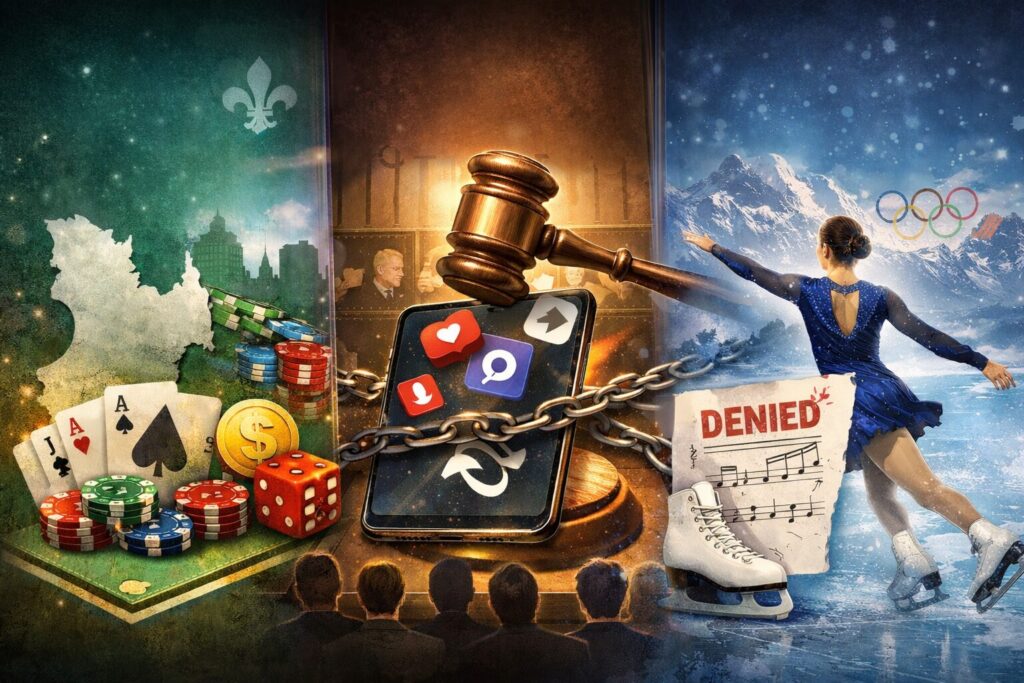
In this week’s GME3, Québec’s online gambling debate is back in the spotlight, with an industry coalition telling the province’s finance ministry that the current “Loto-only” approach is bleeding both consumer protection and tax revenue as players keep drifting to offshore sites. In the U.S., a bellwether “youth harms” trial is putting Big Tech’s design choices under a microscope, with plaintiffs arguing features like infinite scroll were built to hook minors. And over in Milan Cortina, the Olympics’ figure skating events have a surprise antagonist: copyright clearance, as skaters scramble to secure last-minute approvals (or ditch planned music entirely). Read the full stories below!
Gambling
Open Market Closes Loopholes
The Québec Online Gaming Coalition has submitted a brief to Québec’s Ministry of Finance as part of the province’s pre-budget consultations, arguing that Québec’s current online gambling model is failing on both consumer protection and public revenue. The coalition says the unregulated market is exposing vulnerable people to higher risks while costing the province more than $300 million per year in lost tax revenue.
In a press release issued Monday, the coalition – whose members include Bet99, DraftKings, Flutter, Entain, Apricot Investments, betway, Games Global, and Rush Street – renewed its call for Québec to adopt an open, regulated online gambling framework. The coalition’s core point is that limiting legal online gambling to platforms operated by Loto-Québec does not reflect how Québecers actually gamble online. In its view, players are routinely using offshore or otherwise unregulated sites that offer broader product selection but lack consistent safeguards, oversight, and accountability.
The coalition argues Québec could apply common regulatory requirements, such as rules around advertising, age verification, and operator accountability, to private-sector platforms as well as Loto-Québec, “channelling” most online gaming activity into a stable, regulated environment.
To support that shift, the brief makes four recommendations: (1) appoint an independent regulator to oversee all online operators, public and private; (2) develop Québec-specific standards in consultation with stakeholders; (3) establish licensing criteria and revenue-sharing agreements with the government; and (4) earmark a portion of private-market revenue for community support and enhanced prevention funding.
Media
Algorithm Addiction Allegations
Jurors in Los Angeles are hearing opening statements in the closely watched social media “youth harms” lawsuit that could shape thousands of similar cases nationwide. The trial centers on a 20-year-old plaintiff identified as “KGM,” one of three plaintiffs chosen for bellwether trials. The remaining defendants are Meta (owner of Instagram) and Google/YouTube, as TikTok and Snap have already settled.
Plaintiffs’ counsel Mark Lanier framed the case as “addicting the brains of children,” likening social media platforms to casinos, addictive drugs, and tobacco companies. He told jurors Meta and YouTube intentionally designed addictive features – such as infinite scroll – and supported his argument with internal emails, documents, and studies. Lanier highlighted Meta’s “Project Myst” survey of teens and parents, arguing it showed the companies understood certain children (including those experiencing trauma or stress) were especially vulnerable, while parental controls had limited impact. He also pointed to internal communications comparing products to casinos and describing Instagram as “like a drug.”
Defence lawyers pushed back on both causation and the “addiction” framing. Meta’s attorney argued the key issue is whether the platforms were a substantial factor in KGM’s mental health challenges, emphasizing difficult childhood circumstances, including bullying, body image issues, and a troubled home environment. YouTube’s lawyer focused on KGM’s usage data – averaging 29 minutes per day over five years and about 1 minute 14 seconds daily on YouTube Shorts – arguing “infinite scroll is not infinite,” and noting features can be disabled or tailored. He also said KGM denied being addicted and that her extensive medical records contain no diagnosis of YouTube addiction.
The trial is expected to last six to eight weeks, with major implications for how platforms design youth-facing features and defend a growing wave of similar lawsuits, including cases brought by states and school districts.
Entertainment
License to Spin
Copyright clearance has emerged as a recurring headache during the opening week of the figure skating program at the Milan Cortina Olympics, forcing some athletes to scramble for last-minute approvals or abandon planned music entirely. Spanish skater Tomas-Llorenc Guarino Sabate nearly had to change his short program while seeking permission to use music from the Minions movie, but ultimately secured approval and skated his planned routine on Tuesday night. By contrast, Russian skater Petr Gumennik failed to clear music from Perfume: The Story of a Murderer and switched just two days before his event to “Waltz 1805” by Edgar Hakobyan.
Another flashpoint involved U.S. skater Amber Glenn, who had been using music by Canadian artist Seb McKinnon. McKinnon was surprised to learn his song was being used, but the two spoke and resolved the issue independently. Canadian ice dancer Piper Gilles summed up the broader confusion: skaters still aren’t always sure what they can use without permission.
The root cause can be traced back to a 2014 rule change by the International Skating Union, which allowed lyrics (previously largely barred), thereby opening the door to modern, copyrighted music rather than public-domain standards. However, modern tracks can involve multiple rights-holders (writers, labels, publishers, and studios) and multiple licenses (venue playback, TV broadcast, online use, and recordings), which are further complicated by international rights and the common practice of mixing several songs per program.
GME Law is Jack Tadman, Daniel Trujillo, and Will Sarwer-Foner Androsoff. Jack’s practice has focused exclusively on gaming law since he was an articling student in 2010, acting for the usual players in the gaming and quasi-gaming space. Lindsay brings her experience as a negotiator and contracts attorney, specializing in commercial technology, SaaS services, and data privacy.
At our firm, we are enthusiastic about aiding players in the gaming space, including sports leagues, media companies, advertisers, and more. Our specialized knowledge in these industries allows us to provide tailored solutions to our clients’ unique legal needs. Reach out to us HERE or contact Jack directly at jack@gmelawyers.com if you want to learn more!
Check out some of our previous editions of the GME3 HERE and HERE, and be sure to follow us on LinkedIn to be notified of new posts, keep up to date with industry news, and more!