
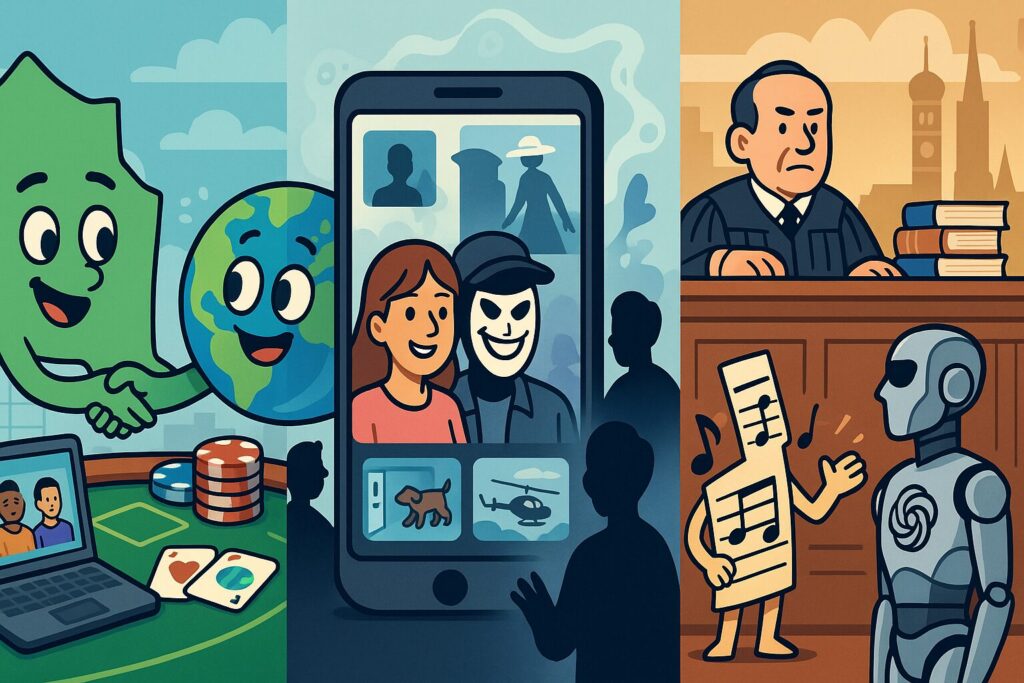
In this week’s GME3, the Ontario Court of Appeals has ruled that international liquidity sharing in the province would, in fact, be lawful, OpenAI’s new Sora 2 video app draws criticism over potential issues including promoting misinformation, deepfakes, and privacy violations, and a Munich court has ruled that OpenAI infringed copyright by using song lyrics to train its models and by enabling their reproduction in ChatGPT outputs. Read the full stories below!
Gambling
Solid Liquidity Ruling
Ontario’s Court of Appeal has cleared a path for bigger poker pools and the possible return of paid daily fantasy sports (DFS) by finding that the province’s “shared liquidity” model would remain lawful. In a 4–1 majority, the court ruled that Ontario players could participate in peer-to-peer games – like poker and DFS – with opponents outside Canada. Ontario-based players will continue to access Ontario-regulated sites, while foreign players use portals regulated in their respective locations. However, linking with other Canadian provinces would still require separate interprovincial agreements. The ruling is a significant boost for Ontario’s iGaming market, which has struggled with limited liquidity since 2022 and saw major DFS operators like DraftKings and FanDuel shutter local DFS offerings under the province’s closed-liquidity rules. iGaming Ontario has acknowledged that the current model discouraged some operators and pushed some play to grey-market options.
Implementation won’t be immediate. A Supreme Court of Canada appeal is still possible, and the province must still negotiate and operationalize agreements with foreign regulators and operators, with many practical details (who selects jurisdictions, who negotiates terms, etc.) still unsettled. The government originally asked the court to weigh in on shared liquidity in February 2024, arguing it mirrors U.S. poker compacts where states share player pools while maintaining local oversight. Supporters say larger, regulated pools could better channel Ontario players into the legal market; opponents, including several provincial lottery and gaming corporations, raised legal and advertising concerns across borders. Even so, the decision marks a clear win for Ontario DFS and poker fans eager for bigger and better regulated games.
Media
Sora About That
Public Citizen, a U.S. consumer advocacy nonprofit, urged OpenAI to withdraw its AI video app Sora 2, warning in a letter to CEO Sam Altman and Congress that the release reflects a “dangerous pattern” of rushing unsafe products to market. The group argues Sora 2 heightens risks of misinformation, deepfakes, and privacy violations, eroding public trust and enabling non-consensual uses of people’s likenesses. It cites viral, hyper-shareable formats (e.g., fake doorbell footage or fabricated celebrity clips) as vectors for rapid spread and “first-impression” political manipulation. While OpenAI blocks nudity and has tightened rules around public figures after outcry from estates and unions, critics say harmful content still slips through. For instance, 404 Media recently reported on a wave of Sora-generated strangulation videos.
Sora launched on iOS over a month ago and expanded to Android in the U.S., Canada, Japan, and South Korea. Entertainment sectors, from Hollywood to Japanese manga publishers, have pushed back over rights and reputational harms. In response, OpenAI has framed early “over-moderation” as a conservative, temporary stance and specific announced agreements limiting depictions of Martin Luther King Jr. and collaborations with SAG-AFTRA and talent agencies. The company also says it’s engaging Japanese rights holders and applying guardrails to deter unauthorized character generation.
Public Citizen links Sora’s rollout to broader concerns raised in recent lawsuits against ChatGPT that allege harmful psychological effects and inadequate safety testing (though the group isn’t a party to those cases). At the core of its claim, the group argues that these risks were foreseeable, and OpenAI should stress-test and design stronger safeguards before mass release rather than apologizing after harms occur.
Entertainment
GEMA Over, Man
A Munich court ruled that OpenAI infringed copyright by using song lyrics to train its models and by enabling their reproduction in ChatGPT outputs, in a case brought by German music rights body GEMA on behalf of the authors of nine songs. The court held that both “memorization” within the language models and subsequent lyric reproduction constitute unlawful uses, entitling the plaintiffs to compensation. OpenAI argued its systems don’t store or copy specific works and that users, not the company, are responsible for outputs; the court rejected those arguments and found liability for both internal reproduction during training and external reproduction in responses.
OpenAI said it disagrees with the decision and is considering next steps, emphasizing that the ruling concerns a limited set of lyrics and does not affect everyday use of its tools across Germany. GEMA, which represents over 100,000 composers, songwriters and publishers, hailed the judgment as a milestone that strengthens creators’ bargaining position and could spur licensing negotiations. Law firm Raue, which represented GEMA in the suit, called the decision a precedent with implications beyond Germany, potentially influencing protection for other forms of creative content across Europe. The German Journalists’ Association likewise welcomed the ruling as a major win for copyright.
Filed in November 2024, GEMA’s suit is the first significant European case targeting AI training on lyrics without licenses. The verdict adds momentum to a broader wave of global litigation over AI training data and may set expectations for paid licensing frameworks between AI companies and rights holders.
GME Law is Jack Tadman, Lindsay Anderson, and Will Sarwer-Foner Androsoff. Jack’s practice has focused exclusively on gaming law since he was an articling student in 2010, acting for the usual players in the gaming and quasi-gaming space. Lindsay brings her experience as a negotiator and contracts attorney, specializing in commercial technology, SaaS services, and data privacy.
At our firm, we are enthusiastic about aiding players in the gaming space, including sports leagues, media companies, advertisers, and more. Our specialized knowledge in these industries allows us to provide tailored solutions to our clients’ unique legal needs. Reach out to us HERE or contact Jack directly at jack@gmelawyers.com if you want to learn more!
Check out some of our previous editions of the GME3 HERE and HERE, and be sure to follow us on LinkedIn to be notified of new posts, keep up to date with industry news, and more!