
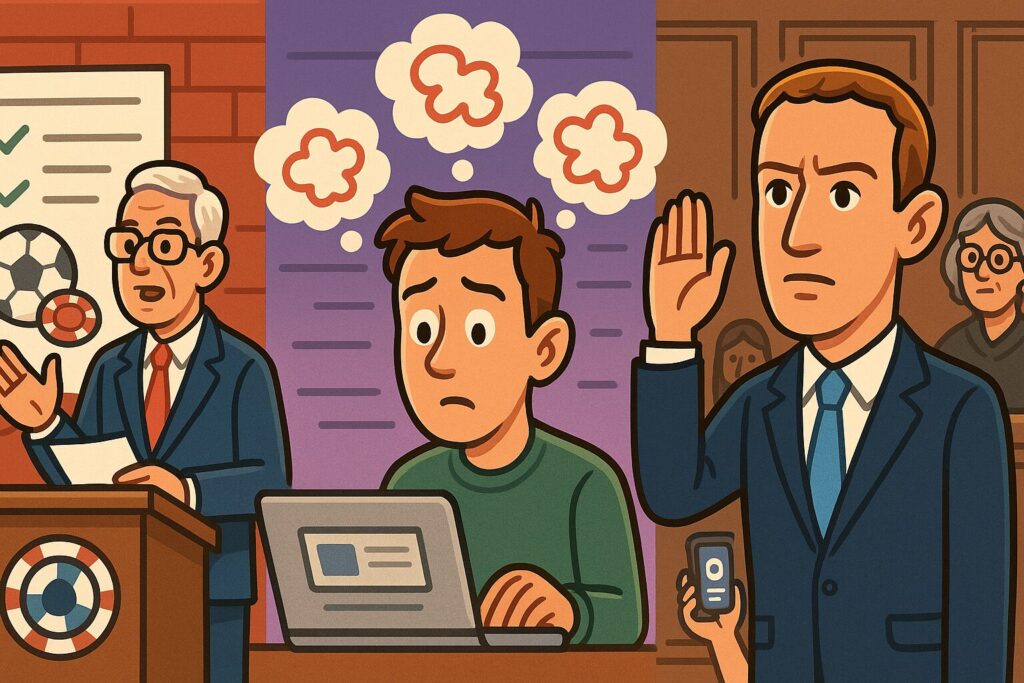
In this week’s GME3, the Canadian Senate has now passed Senator Marty Deacon’s sports betting ad bill for a second time, a new study from European broadcasters reveals the true scope of “hallucinations” that AI assistants can present to users about news content, and a California judge has ordered major social media company CEOs to testify over the alleged harm social media causes to young users. Read the full stories below!
Gambling
2 Bill, 2 Furious
Once again, the Canadian Senate has passed Senator Marty Deacon’s Bill S-211 (the National Framework on Sports Betting Advertising Act), which aims to create federal guidelines for how sports betting operators advertise. The bill, identical to last year’s S-269, passed swiftly and without opposition, reflecting continued concern over the surge of gambling ads since single-event sports betting was legalized in 2021.
If enacted, S-211 would require the Minister of Canadian Heritage to establish a national framework that could restrict the “number, scope, or location” of betting advertisements, limit celebrity and athlete endorsements, and potentially introduce “whistle-to-whistle” ad bans during live broadcasts. The bill also proposes standards for identifying and addressing gambling addiction and for supporting those affected. While Deacon has expressed support for a full ad ban, she acknowledged that constitutional challenges under the Charter make such an approach unrealistic for now.
Proponents – including mental health and youth advocacy groups – argue that national oversight is necessary as regulated and unregulated betting promotions appear across Canada, even in provinces without open markets. Critics, led by the Canadian Gaming Association (CGA), counter that federal intervention could undermine effective provincial regulation and industry progress. The CGA, along with thinkTV, the Canadian Association of Broadcasters, and the Responsible Gambling Council, points to evidence that gambling advertising is already declining. thinkTV reports annual decreases in ad volume, and CGA data show online betting ad spending fell 7 percent in 2023 and another 1 percent in 2024, with iGaming representing only 5 percent of total ad content. The bill now moves to the House of Commons, where it previously stalled after Parliament was prorogued in January 2025.
Media
Hallucinating Headlines
A new international study by the European Broadcasting Union (EBU) and the BBC has found that leading AI assistants misrepresent or mishandle news content in nearly half of their responses. The research analyzed 3,000 answers from OpenAI’s ChatGPT, Microsoft’s Copilot, Google’s Gemini, and Perplexity across 14 languages, assessing factual accuracy, sourcing, and ability to distinguish between opinion and fact.
Overall, 45% of responses contained at least one significant issue, and 81% had some kind of problem. A third of all responses showed major sourcing errors, such as missing, misleading, or incorrect attribution, with Gemini performing worst, showing issues in 72% of cases. Roughly 20% of responses across all systems contained factual inaccuracies or outdated information. The study cited examples like Gemini misreporting a vaping law change and ChatGPT continuing to refer to Pope Francis as alive months after his death.
The findings come as AI assistants are becoming a growing source of news, especially among younger users. According to the Reuters Institute’s Digital News Report 2025, 7% of online news consumers, and 15% of those under 25, now primarily use AI tools to stay informed.
In response, AI companies have acknowledged ongoing challenges. OpenAI and Microsoft have said they’re working to reduce “hallucinations,” while Google and Perplexity claim to have made progress in factual accuracy and feedback mechanisms.
The EBU warned that unreliable AI-generated news responses risk eroding public trust and democratic engagement, calling on tech firms to adopt accountability standards similar to traditional news organizations, such as transparent sourcing, error correction, and clear labelling of information accuracy.
Entertainment
He Zuck to His Word
A California judge has ordered Meta CEO Mark Zuckerberg, Instagram chief Adam Mosseri, and Snap CEO Evan Spiegel to testify in a major upcoming trial over the alleged harm social media causes to young users. The case, set for January 2026 in Los Angeles County Superior Court, is one of the first to reach trial among hundreds of lawsuits filed by parents and school districts accusing Meta, Snap, TikTok, and YouTube of designing addictive platforms that exploit children’s attention and damage mental health.
Judge Carolyn Kuhl rejected Meta’s argument that forcing top executives to appear in person would be an undue burden, writing that their testimony was “uniquely relevant” to determining what the companies knew about potential harms and what steps they failed to take to prevent them. Plaintiffs claim the firms intentionally prioritized engagement and profit over user safety, citing ineffective parental controls and features like notifications that keep teens hooked.
Meta, Snap, and the other defendants have denied wrongdoing, arguing they are protected by a 1990s federal law shielding internet platforms from liability for user-generated content. However, Judge Kuhl ruled that the companies must still face negligence and personal-injury claims related to how their apps are designed.
Lawyers for the plaintiffs praised the decision, saying it will finally hold the executives accountable. Meta and Snap maintained that the ruling does not validate the claims and said they look forward to defending their products. The lawsuit comes amid intensifying scrutiny of social media’s impact on youth, with Meta introducing new “teen accounts” and stricter content filters in response to rising political and legal pressure.
GME Law is Jack Tadman, Lindsay Anderson, and Will Sarwer-Foner Androsoff. Jack’s practice has focused exclusively on gaming law since he was an articling student in 2010, acting for the usual players in the gaming and quasi-gaming space. Lindsay brings her experience as a negotiator and contracts attorney, specializing in commercial technology, SaaS services, and data privacy.
At our firm, we are enthusiastic about aiding players in the gaming space, including sports leagues, media companies, advertisers, and more. Our specialized knowledge in these industries allows us to provide tailored solutions to our clients’ unique legal needs. Reach out to us HERE or contact Jack directly at jack@gmelawyers.com if you want to learn more!
Check out some of our previous editions of the GME3 HERE and HERE, and be sure to follow us on LinkedIn to be notified of new posts, keep up to date with industry news, and more!