
Prediction markets have been taking up a significant amount of oxygen in the U.S. gaming space. My current favourite reads on the topic are 50¢ Dollars, by Adhi Rajaprabhakaran, an early (former) Kalshi employee and pro prediction market trader, and The Event Horizon by gaming industry veteran Dustin Gouker.
Given the size and scope of the U.S. market, what happens in the U.S. typically has a global impact. Last week, Kalshi announced a $300m raise (at a $5b valuation) and an expansion to 140 countries.
Going to practice my cold-reading skills on the non-American readers of the blog: you’re probably thinking, “Is my country included?” I’m thankful to Alex Weldon at PokerScout for making it SO EASY to find this information by titling his article “Kalshi Announces International Service Alongside $300 Million in New Funding — Which Countries Are Still Excluded?”
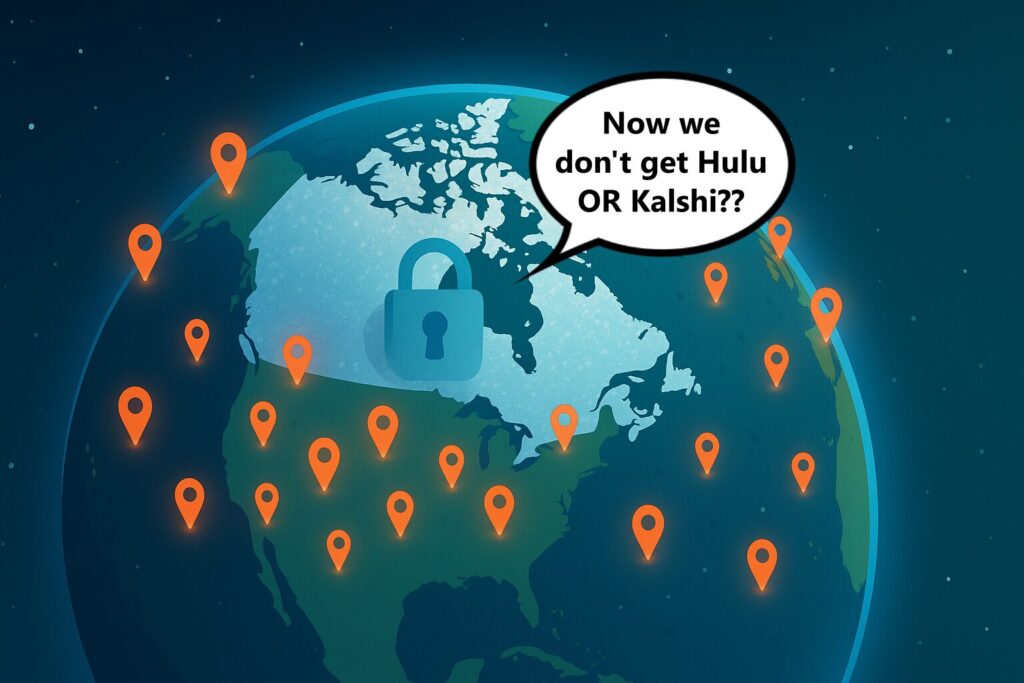
Canada Still Restricted
I was moderately surprised to discover that Canada is still on Kalshi’s restricted list. Announcing that you will be providing your services to 140 countries (without licenses) is a risk profile generally reserved for iGaming operators that are either (i) licensed in hub jurisdictions like Curacao or Anjouan or (ii) not licensed at all. Almost all of those sites accept players located in Canada (some exclude Ontario), which reflects the lack of action taken and the lack of success that Canadian authorities have had in stopping iGaming operators not authorized by provincial authorities.
Surprisingly, one area where Canadian (or Ontario, at least) authorities have had success is with respect to Prediction Markets. The Ontario Securities Commission (“OSC”) entered into a settlement agreement with the current and former operators of Polymarket in 2025 (we wrote about it HERE, and Geoff Zochodne of Covers also did a terrific job summarizing the situation HERE). The settlement agreement was related to Polymarket’s failure to comply with the ban on short-term binary options. The OSC contacted Polymarket in May 2023, and Polymarket has prohibited players located in Ontario since that time.
What’s a Binary Option?
In 2017, the Canadian Securities Administrators (a coalition of securities regulators from all 10 provinces and 3 territories) introduced Multilateral Instrument 91-102, imposing a ban on offering binary options to retail investors across the country.
According to the Instrument, a binary option is:
A contract or instrument that provides for only
(a) a predetermined fixed amount if the underlying interest referenced in the contract or instrument meets one or more predetermined conditions, and
(b) zero or another predetermined fixed amount if the underlying interest referenced in the contract or instrument does not meet one or more predetermined conditions.
A short-term binary option, which is the type of binary option that is prohibited, has a maturity date of 30 days or longer. The Instrument also provides that the regulator or securities regulatory authority may grant an exemption to the prohibition on short-term binary options.
Canada Still in Play?
Back to Kalshi, and the countries it still blocks, it’s an interesting list, and I encourage you to read it.
At this point, it’s safe to assume that Kalshi is up to something in Canada. The risk profile of an operation that is active in 140 countries without licensing is such that I would also expect them to be active in Canada, except maybe Ontario. For instance, Polymarket was fined by the OSC and remains active in the rest of Canada. So, why not Kalshi?
I have more to write on this, which I’ll save for another article, but I’ll leave you with this thought: Gambling is prohibited in Canada (subject to exemptions), and that prohibition is in the Canadian Criminal Code, which is federal legislation. The Criminal Code prohibitions explicitly separate gaming and betting as different activities, and while there is an exemption for games of skill, there is no such exemption for “skill betting”.