
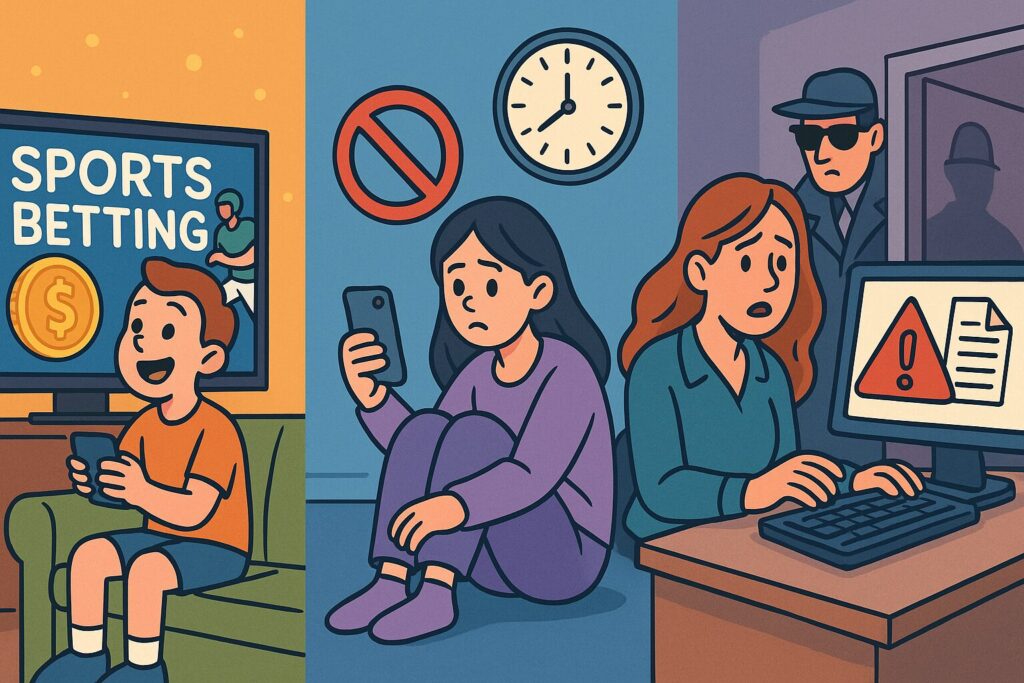
In this week’s GME3, Canadian doctors are – once again – sounding alarms over the flood of sports betting ads during games, warning that they normalize gambling for children and risk fueling a new generation of addiction. Also in Canada, a $68-million federal project meant to modernize Canada’s asylum system collapsed without ever completing legally required privacy safeguards, raising fresh concerns about the safety of refugee claimants’ most sensitive data. And in France, lawmakers are taking aim at TikTok and other platforms, proposing bans for under-15s and digital curfews for teens after finding what they call an “ocean of harmful content” tied to self-harm and disordered behaviour. Read the full stories below!
Gambling
Major Wagers for Minors
Doctors and public health experts are raising alarms about the growing exposure of Canadian youth to sports betting ads, warning that it is fueling an increase in underage gambling and long-term addiction risks. In an editorial for the Canadian Medical Association Journal, Dr. Shannon Charlebois and Dr. Shawn Kelly highlighted how the legalization of online gambling has turned every smartphone into a betting device, while relentless advertising during sports broadcasts normalizes gambling for children and teens. Kelly, an adolescent addiction specialist, says he now routinely screens young patients for gambling behaviours and has seen cases involving 13- and 14-year-olds racking up significant losses with borrowed credit cards.
A 2023 survey of over 38,000 B.C. students found that online gambling among youth has increased since 2018. Research from Norway, the U.K., and Canada similarly shows hundreds of teenagers reporting moderate to severe gambling problems, with associated harms ranging from substance abuse and delinquency to heightened suicide risk. Experts note that most gambling problems later in life begin before age 19, when habits and brain development make young people especially vulnerable.
Advocates such as Charlebois argue that stricter rules are needed to limit youth exposure, including curbing ads during games and removing them from social media platforms. She points to a Senate bill proposing tighter regulation of gambling ads as a positive step. Critics like University of Toronto professor Bruce Kidd say that betting promotions “poison the idea of sport” by equating fandom with wagering. The gaming industry, represented by Canadian Gaming Association CEO Paul Burns, counters that gambling ads make up only a small share of total advertising and emphasizes education and awareness over restrictions.
Since the publishing of the editorial, the Canadian Gaming Association (CGA) has pushed back against calls to curb sports betting ads, arguing that prohibition would not stop gambling but instead drive players to unregulated markets. Ontario’s regulated iGaming framework, launched in 2022, is highlighted as a model, with over 20 advertising and responsible gambling rules in place, including restrictions on celebrity endorsements, bans on mass-market bonus ads, mandatory staff training, and robust player protection tools like deposit limits and self-exclusion. The CGA also notes that ad volume is already declining, with online gambling representing just 5% of TV ad spend and less than 5% of ads during NHL and NBA games in 2024. Responsibility for ad placement, they stress, is shared with broadcasters, leagues, and regulators – not operators alone. While critics point to youth exposure, the CGA underscores that licensed Ontario operators enforce strict age verification, unlike unregulated sites elsewhere in Canada. Their central rebuttal comes down to the idea that regulation and evidence-based safeguards, not advertising bans, are the most effective way to protect players. You can read the CGA’s full response HERE.
Media
PIA? MIA
Canada’s $68-million asylum interoperability project – launched in 2019 to digitize refugee applications and streamline inter-agency data sharing – has come under fire after documents revealed that Immigration, Refugees and Citizenship Canada (IRCC), the Canada Border Services Agency (CBSA), and the Immigration and Refugee Board (IRB) failed to complete mandatory privacy impact assessments (PIAs) throughout the project’s lifespan. Despite Treasury Board rules requiring PIAs before implementing new or modified IT systems, the assessments remain unfinished even though the project was quietly scrapped in 2024 at only 64 per cent completion.
Lawyers and privacy experts warn that this oversight raises serious red flags, potentially leaving vulnerable refugee claimants’ highly sensitive data exposed. Privacy lawyer Andrew Koltun criticized the departments for playing “hot potato” with responsibility and pursuing rapid digital modernization without adequate safeguards, calling the approach dangerous in the refugee context. Refugee lawyer Greg Willoughby recounted repeated instances of IRCC misdirecting confidential client information, including one case where private documents were sent to family members a claimant was fleeing – an error he described as traumatizing.
The project itself introduced major changes, including an online refugee application system, automation, and real-time data sharing between agencies. It also allowed automatic cancellation of work and study permits tied to removal orders. While IRCC maintains the initiative simply built secure IT interfaces without changing the type of information collected, critics argue this still triggered legal obligations to conduct updated PIAs.
Internal records suggest confusion over which agency was responsible, with IRCC initially expected to lead one comprehensive PIA before later shifting responsibility to each partner. Ultimately, CBSA abandoned its PIA, IRB relied on older assessments, and IRCC says it will complete its review by late 2025. Experts say these responses are inadequate and risk undermining both legal compliance and the privacy rights of refugees.
Entertainment
Bedtime Ban
French lawmakers are pushing for sweeping restrictions on youth social media use, targeting TikTok as a primary concern. A new parliamentary report recommends banning platforms for children under 15 and introducing a “digital curfew” barring 15- to 18-year-olds from using social media between 10 p.m. and 8 a.m. Report author Laure Miller said the measures would send a clear signal that social media is “not harmless” for children, pointing to widespread exposure to harmful content.
The inquiry was launched after a 2024 lawsuit in which several families accused TikTok of exposing children to videos encouraging suicide and self-harm. Lawmakers say they found “an ocean of harmful content” on the platform, with its algorithm creating addictive “bubbles” of violence, body image pressures, and self-destructive behaviour. Critics argue TikTok failed to adequately moderate such material, with parents testifying that their children were drawn deeper into mental health struggles. A lawyer representing the families welcomed the recommendations, while committee chair Arthur Delaporte announced plans to file a criminal complaint against TikTok for “deliberately endangering lives” and alleged perjury by executives during testimony.
TikTok, owned by China-based ByteDance, rejected the report’s findings, calling itself a scapegoat for broader social issues. The company insists youth safety is its “top priority” and points to AI moderation that it says intercepted 98% of harmful content in France last year. But lawmakers counter that the rules are easily bypassed through coded language, and victims’ families argue moderation remains inadequate.
The debate comes amid wider global scrutiny of TikTok, with concerns about mental health, misinformation, and foreign influence. French President Emmanuel Macron has already voiced support for restrictions, following similar moves in Australia and ongoing legal battles in the U.S. If platforms fail to comply with European standards within three years, lawmakers suggest the proposed ban could be extended to all users under 18.
GME Law is Jack Tadman, Lindsay Anderson, and Will Sarwer-Foner Androsoff. Jack’s practice has focused exclusively on gaming law since he was an articling student in 2010, acting for the usual players in the gaming and quasi-gaming space. Lindsay brings her experience as a negotiator and contracts attorney, specializing in commercial technology, SaaS services, and data privacy.
At our firm, we are enthusiastic about aiding players in the gaming space, including sports leagues, media companies, advertisers, and more. Our specialized knowledge in these industries allows us to provide tailored solutions to our clients’ unique legal needs. Reach out to us HERE or contact Jack directly at jack@gmelawyers.com if you want to learn more!
Check out some of our previous editions of the GME3 HERE and HERE, and be sure to follow us on LinkedIn to be notified of new posts, keep up to date with industry news, and more!