
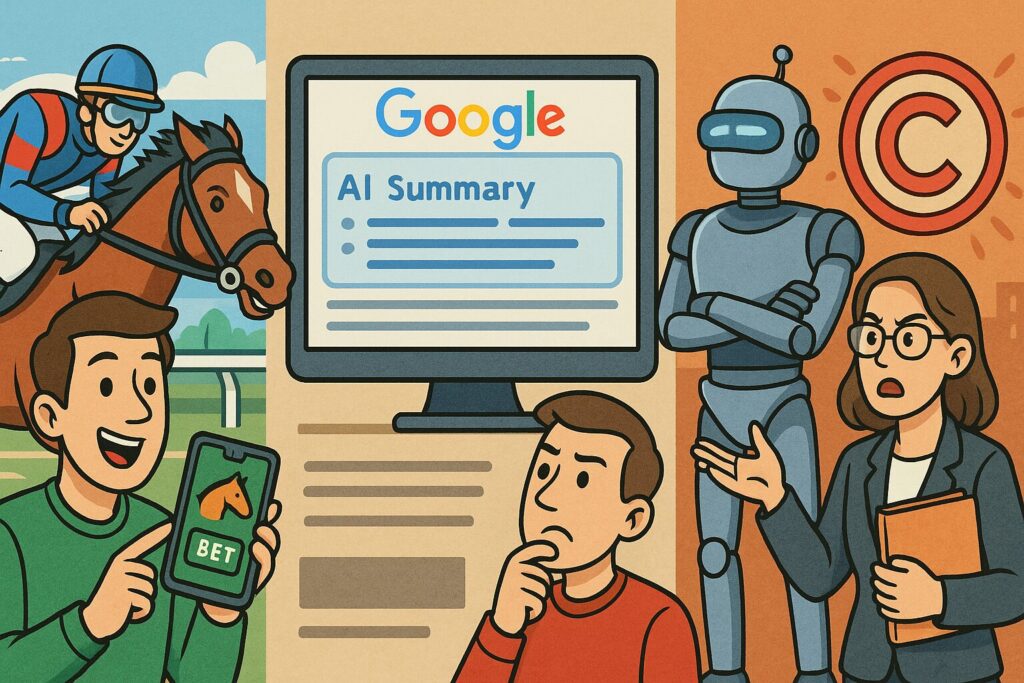
In this week’s edition of the GME3, Ontario’s gambling scene is off to the races with OLG’s new deal to offer online horse betting through Woodbine Entertainment, while the media world is grappling with Google’s AI-powered search summaries that publishers say are cutting traffic and revenue. In entertainment, the copyright clash between Disney, Universal, and Midjourney is heating up, as the AI image generator pushes back with a fair use defence and accuses the studios of benefiting from the very tools they’re targeting. Read the full stories below!
Gambling
A One-Horse Race
Ontario bettors now have expanded options for online and mobile horse racing wagers thanks to a new partnership between Ontario Lottery and Gaming Corporation (OLG) and Woodbine Entertainment Group (WEG). Launched August 12, this marks the first time a Canadian provincial lottery has offered parimutuel wagering on live horse races via its digital platforms.
WEG, Canada’s largest horse racing operator and the only federally authorized provider of horse race betting, runs the markets through its HPIbet-powered platform. All betting is parimutuel – players contribute to a shared pool with winnings divided among successful bets – since fixed-odds wagering on horse racing is federally prohibited.
Under the agreement, OLG integrates WEG’s “plug-and-play” betting interface into its iGaming and PROLINE+ sportsbook, while WEG manages operations. The collaboration aims to boost player engagement and direct revenue back into Ontario’s horse racing industry, which WEG reinvests entirely due to its non-share-capital structure.
This isn’t WEG’s first digital expansion – Bet365 became the first regulated Ontario sportsbook to offer parimutuel racing in 2023 using WEG data. OLG’s product, however, uses a separate interface built in partnership with WEG.
The new plug-and-play solution could soon reach other licensed Ontario sportsbooks, with WEG in discussions to license its interface more widely. For now, Ontarians can place legal online horse racing bets only through HPIbet, Bet365, or OLG. WEG CEO Michael Copeland says the deal enhances accessibility, modernizes the betting experience, and supports the sport’s growth in the province.
Media
Moe’ Tech/Moe’ Problems
Google’s AI Overview feature, which generates AI-written summaries at the top of many search results, is drawing criticism from news publishers and academics for reducing web traffic to news sites and raising accuracy concerns. Since its launch last year – marked by early errors like suggesting glue for pizza toppings – experts warn the technology’s underlying limitations may persist even as it improves. Jessica Johnson of McGill University’s Centre for Media, Technology and Democracy says the change to how people search has come with little public debate, while University of Washington professor Chirag Shah highlights that generative AI can misinterpret flawed or satirical sources, a problem not solved by simply adding more data or computing power.
Research shows AI summaries reduce click-through rates: a Pew study found users clicked links only 8% of the time when an AI summary appeared, compared to 15% without one. Publishers say this “zero-click” behaviour hurts revenue, as casual news consumers may consider the summary sufficient. Paul Deegan of News Media Canada calls it a drag on engagement, while Alfred Hermida of UBC notes Google was once a key traffic driver. Competition concerns are also emerging, with the Canadian Anti-Monopoly Project warning of parallels to past antitrust cases against Google.
Google disputes claims of traffic declines, saying overall click volume is stable. Still, experts like Clifton van der Linden caution that “useful” summaries are not always credible, and in Canada, they compound existing challenges from Meta’s ban on news links under the Online News Act. Johnson calls the combined impact of Meta’s actions and AI summaries a “one-two punch” for an already struggling news industry, questioning the sustainability of producing journalism if it’s neither seen nor paid for.
Entertainment
Mouse v. Midjourney
Midjourney has formally pushed back against a June copyright infringement lawsuit from Disney and Universal, arguing its AI image-generation service operates within fair use and that the entertainment giants themselves use generative AI, including Midjourney, for their own benefit. In a 43-page filing in California federal court, the San Francisco-based company highlighted Disney CEO Bob Iger’s public praise of AI as “an invaluable tool for artists” to underscore what it calls the plaintiffs’ inconsistent stance.
Disney and Universal’s suit accuses Midjourney of producing unauthorized reproductions of protected properties such as Star Wars, Marvel, and The Simpsons, likening the platform to a “virtual vending machine” for infringing works. The companies also challenge the legality of training AI models on datasets that may contain frames from their films and shows.
Midjourney rejects these claims as mischaracterizations, comparing AI training to human learning – absorbing styles and patterns rather than memorizing works. It stresses that its terms prohibit IP infringement, but the company cannot determine whether an image violates rights without notice from a copyright holder. It argues Disney and Universal should have used its DMCA takedown process to target specific offending images rather than pursuing broad litigation.
The company warns that the plaintiffs’ approach would suppress legitimate, non-infringing uses of popular culture imagery, chilling lawful expression. It also raises “unclean hands” as a defence, asserting the plaintiffs have themselves benefited from generative AI tools, including concerning the works at issue.
Disney has reiterated its commitment to protecting its “world-class IP” while embracing AI responsibly. Midjourney is seeking full dismissal of the case.
GME Law is Jack Tadman, Lindsay Anderson, and Will Sarwer-Foner Androsoff. Jack’s practice has focused exclusively on gaming law since he was an articling student in 2010, acting for the usual players in the gaming and quasi-gaming space. Lindsay brings her experience as a negotiator and contracts attorney, specializing in commercial technology, SaaS services, and data privacy.
At our firm, we are enthusiastic about aiding players in the gaming space, including sports leagues, media companies, advertisers, and more. Our specialized knowledge in these industries allows us to provide tailored solutions to our clients’ unique legal needs. Reach out to us HERE or contact Jack directly at jack@gmelawyers.com if you want to learn more!
Check out some of our previous editions of the GME3 HERE and HERE, and be sure to follow us on LinkedIn to be notified of new posts, keep up to date with industry news, and more!