
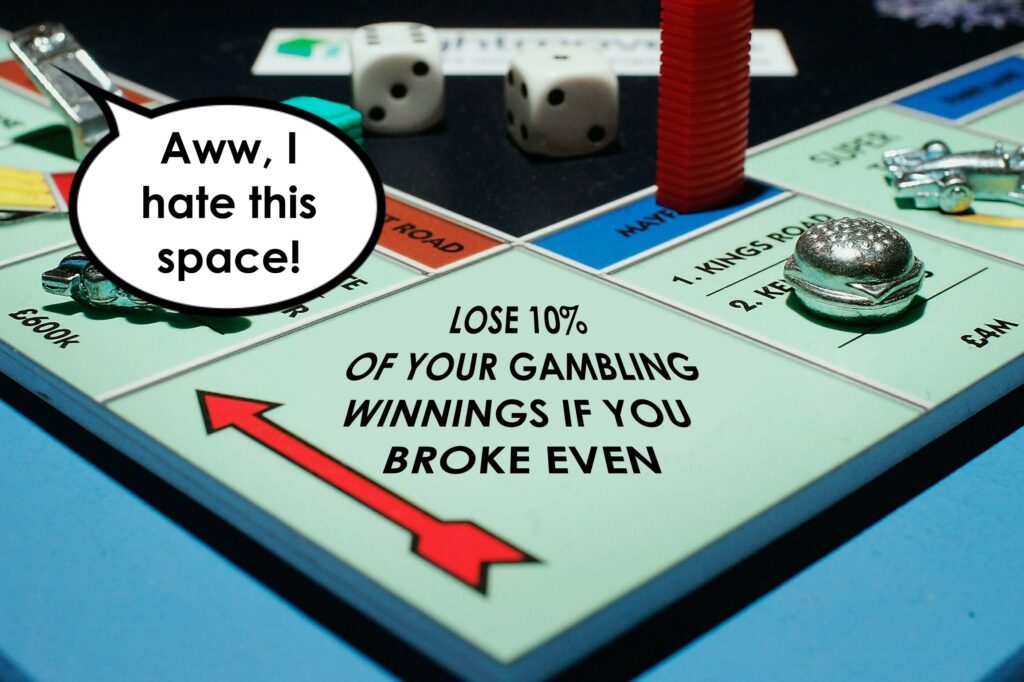
Changes to the way gambling winnings are taxed in the United States have been in the news recently. In summary, as of January 1, 2026, U.S. taxpayers can write off up to 90% (down from 100%) of their documented gambling losses against their winnings, meaning that some people could owe tax even if they “break even” in a calendar year. Efforts in Congress to undo the 90% cap (with catchy names like the FAIR BET Act and the FULL HOUSE Act) have yet to gain real traction. Additional changes, like a tweak to slot-reporting which aims to raise the W-2G threshold to $2,000 and index it to inflation, won’t kick in until the IRS updates its regulations, so casinos will continue issuing W-2Gs at $1,200 for now.
The Canadian Approach
In Canada, we have a much friendlier approach towards gambling winnings. For most people, gambling winnings are treated as a windfall and are tax-free. However, in certain circumstances, gambling winnings are treated as income from a business.
Typically, determining whether an activity is income from a business would involve the test set out in Stewart v. Canada, 2002 SCC 46, which looks at whether the activity is undertaken in pursuit of profit or whether it is a personal endeavour.
The problem with applying this to gambling is that people convince themselves they can make money gambling, but the math doesn’t check out. In other words, as expressed by Justice Bowman in a famous Canadian tax case involving two brothers who won significant sums of money betting on sports (Leblanc v. the Queen, 2006 TCC 680),
“compulsive gamblers, whether they play lotteries or gaming tables, may spend a lot of time and money gambling and they certainly do so with a view to winning. People who go every day to the racetrack devote time and money to this pastime, and after a while they may develop a degree of expertise, or at least persuade themselves that they do.”
Another issue with the Stewart approach from a policy perspective is what to do with the gambling losses of people who claim that such losses are income from a business. For instance, Toronto lawyer Steve Cohen was terminated from his position and claimed to have spent 2006 studying and playing poker. Cohen lost around $120k Canadian over the year and attempted to deduct this amount as business losses. The court was not convinced that Cohen’s actions were those of a professional, questioning whether he was a skilled player and whether he was calculated and disciplined.
Party, Poker (Sleep, and Eat)?
Historically, gamblers have had success with challenging assessments of their gambling activity as income from a business. However, in 2023 (upheld by the Federal Court of Appeal in 2025), the Tax Court of Canada found the activities of three poker players constituted income from a business.
Here are the factors used by the court to determine that the poker winnings should be taxed:
The poker activities they undertook were much more than mere entertainment or recreation.
They played poker to earn a living, making them professional poker players.
Their poker activities represented their only, or at least main, source of income.
They devoted almost all of their time, apart from when they were sleeping, eating, or partying, to poker.
Based on their poker earnings, they were able to make a profit on a yearly basis both consistently and regularly, even though they could not predictably control the outcomes of poker games.
With this level of earnings over such a long period of time, they could reasonably expect to be able to earn a living by playing poker.
Despite their unconventional lifestyle, they behaved in a “businesslike” manner: they played to win; they had strategies that they adapted depending on the level of the tables and their opponents’ prowess; and they used software programs that allowed them to get information on their opponents’ playing habits, track their earnings on gambling websites and analyze their own statistics.
They adopted objective standards of risk management and minimization, as well as income maximization.
They used their expertise and their abilities to earn their living through poker, a game of chance in which skill plays an important role.
Interestingly, there was another poker case around that time involving Jonathan Duhamel. Duhamel won the main event of the 2010 World Series of Poker and successfully convinced the court that his winnings should be tax-free. Despite “writing” a book about poker (it was ghostwritten), the court found that Duhamel did not follow his own (ghostwritten) advice with respect to strategy and discipline and that he did not behave in a manner consistent with conducting business activities.
Main Takeaways
Poker, as a game of mixed chance and skill (where skill dominates), is an interesting game to look at from a tax perspective. However, the normalization and proliferation (yes, I thought of those words myself) of gambling in Canadian society means that more people are playing different gambling games and benefitting from tools that assist with finding the best available gambling opportunities, which can eventually lead to profitable activities such as bonus hunting and arbitrage. At what point does engaging in these activities become income from a business? Will the courts continue to place more emphasis on whether an activity is profitable in determining whether it is taxable? Compared to the United States, Canada is a better place for gamblers, but determining when gambling winnings are income from a business remains convoluted.