
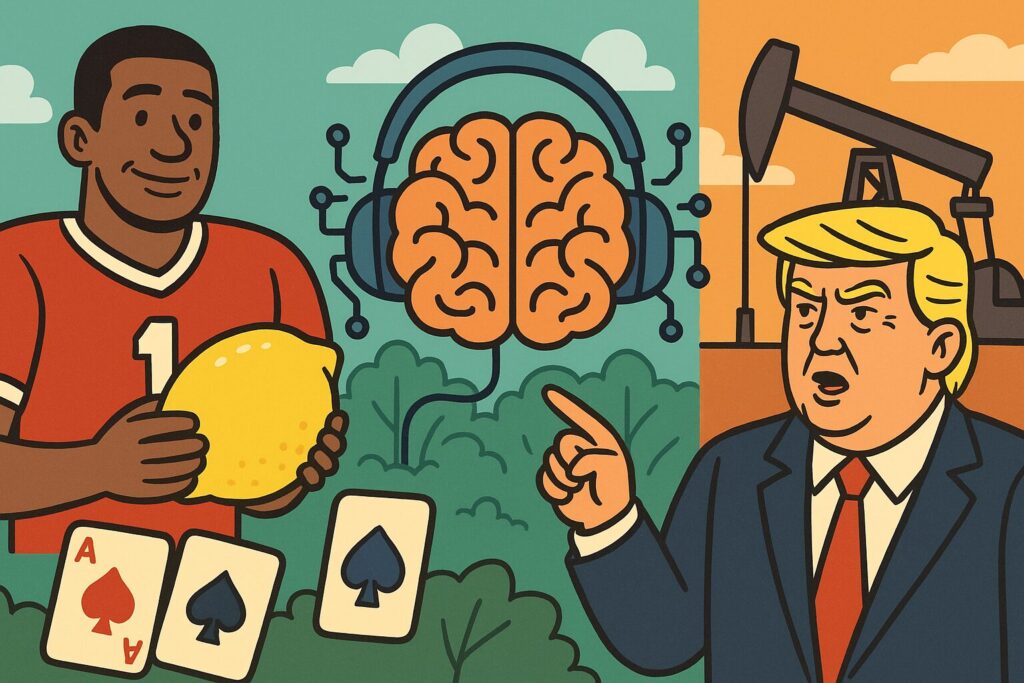
This week’s stories span the fields of sports, privacy, and energy policy. The CFL reinstates veteran defensive end Shawn Lemon following a suspension for gambling violations. In the U.S., several states are moving to regulate neural data as consumer neurotechnology and AI capabilities advance. Meanwhile, Donald Trump’s appearance at an AI and energy summit in Pennsylvania drew criticism for promoting fossil fuels as the future power source for artificial intelligence. Read the full stories below in this week’s GME3!
Gambling
Zest for a Second Chance
Shawn Lemon, a three-time Grey Cup champion, has been reinstated by the Canadian Football League after serving the longest suspension in league history for betting on CFL games. The suspension stemmed from a 2021 incident when Lemon, then with the Calgary Stampeders, was found to have gambled on CFL games, including one in which he played. While the league found no evidence that his wagers impacted game outcomes, his actions violated the CFL’s Match Manipulation Policy, which bans players from betting on CFL games or sharing insider information.
Lemon announced his retirement in early 2024 shortly after signing a contract extension with the Montreal Alouettes, but the announcement came just weeks before the CFL made his gambling violations public. He appealed the indefinite suspension with support from the CFL Players’ Association, but an independent arbitrator upheld it. While banned, Lemon was still allowed to attend training camps, practices, and meetings, though not games.
With his reinstatement, Lemon is eligible to sign with any team, but he must first serve a two-game suspension for a separate violation of the CFL/CFLPA drug policy following a positive test for Phentermine. He is also required to complete league education and continue counselling.
CFL Commissioner Stewart Johnston emphasized that Lemon has taken responsibility and will help educate others. However, the league made it clear that any future gambling violations by players will result in a lifetime ban.
Media
Fossil-Fueled Futures
Donald Trump sparked controversy this week by headlining the inaugural Pennsylvania Energy and Innovation Summit in Pittsburgh, where he announced $70 billion in AI and energy investments for the state. The summit, hosted by Republican Senator Dave McCormick and held at Carnegie Mellon University, aimed to position Pennsylvania as a global hub for artificial intelligence, powered not by renewables but by fossil fuels.
Alongside Trump’s pledge, 20 major tech and energy companies revealed an additional $92 billion in AI investments. Trump emphasized fossil fuels over wind and solar, dismissing renewables as unreliable despite expert consensus that clean energy is essential to meeting AI’s massive electricity demands. His remarks and the summit’s fossil-fuel-heavy framing drew strong backlash from environmentalists and public interest groups who were not invited to participate.
Critics argue the summit is a thinly veiled push to entrench fossil fuel interests under the banner of technological progress. The event followed a Republican-backed budget bill that rolled back green energy tax incentives, potentially making it more expensive to power AI infrastructure in the long run. Major tech leaders like Microsoft’s Satya Nadella and OpenAI’s Sam Altman have previously stated that clean energy is vital to AI’s scalability.
Environmental groups warn that the surge in AI-powered data centers, known to consume vast amounts of energy, will worsen climate change and hurt local communities. Activists called for investment in renewable infrastructure and a just energy transition, not corporate-driven expansions of oil and gas. With AI’s future now deeply tied to energy politics, the summit highlights a widening divide between tech’s environmental aspirations and political alliances driving its growth.
Entertainment
Privacy No-Brainer
As neurotechnology advances and AI becomes more capable of interpreting brain signals, U.S. states are moving to protect neural data – the information generated by people’s brains and nervous systems. Colorado, California, and Montana have passed new laws regulating how consumer devices, such as earbuds and headbands, collect, use, and share brain data. These laws aim to fill a regulatory gap, as such data often falls outside traditional medical protections like HIPAA.
Advocates warn that while current devices gather relatively basic information, future tools powered by AI could extract far more sensitive insights, ranging from medical diagnoses to emotional states or even thoughts. A 2023 report from the Neurorights Foundation found that nearly all companies selling neurotech products online can access and share user brain data, often without meaningful user protections.
These new state laws reflect growing bipartisan concern. Colorado and Montana require explicit consent to collect and share neural data, and all three states mandate a way for users to delete their data. Lawmakers like Montana’s Sen. Daniel Zolnikov emphasize that brain data should be fully owned and controlled by the individual.
While these state laws are a step forward, experts argue that broader federal protections are needed. The American Medical Association has called for stricter neural data regulations, and advocates hope the groundwork laid by states can shape national policy to safeguard neural rights in the face of rapidly evolving technology.
GME Law is Jack Tadman, Lindsay Anderson, and Will Sarwer-Foner Androsoff. Jack’s practice has focused exclusively on gaming law since he was an articling student in 2010, acting for the usual players in the gaming and quasi-gaming space. Lindsay brings her experience as a negotiator and contracts attorney, specializing in commercial technology, SaaS services, and data privacy.
At our firm, we are enthusiastic about aiding players in the gaming space, including sports leagues, media companies, advertisers, and more. Our specialized knowledge in these industries allows us to provide tailored solutions to our clients’ unique legal needs. Reach out to us HERE or contact Jack directly at jack@gmelawyers.com if you want to learn more!
Check out some of our previous editions of the GME3 HERE and HERE, and be sure to follow us on LinkedIn to be notified of new posts, keep up to date with industry news, and more!