
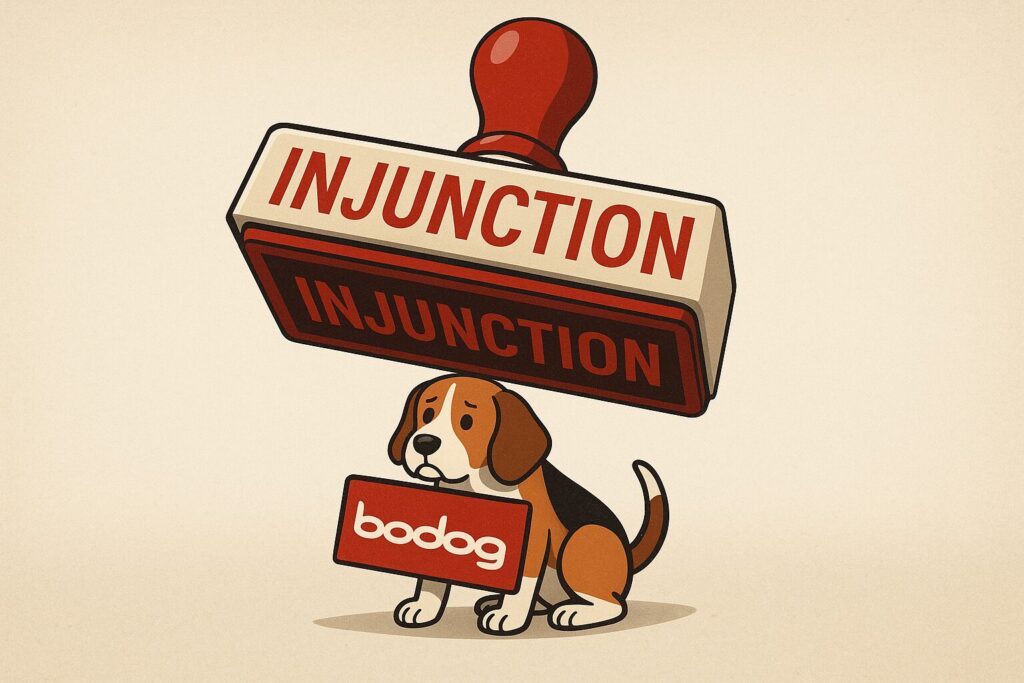
If you are reading this (and aren’t related to me), it’s probably because you’re interested in the Canadian gaming landscape and maybe even Canadian gaming law. If that’s the case, then you’re likely familiar with the Bodog case in Manitoba. A few weeks ago, Justice Harris released his reasoning in the Bodog case, granting the applicant, Manitoba Liquor and Lotteries, everything it asked for. If you’re an operator in the Canadian market (excluding Ontario) or supplying goods and services to operators in this market, this decision may impact you. How? You’ll have to read below (or generate an AI summary of this article) to find out.
For the facts of the case, check out Tom Nightingale’s article for Canadian Gaming Business. Too busy? Here’s a quick recap courtesy of ChatGPT:
A Manitoba judge permanently banned Bodog from operating or advertising in the province, finding its activities illegal under the Criminal Code, Competition Act, and Trademarks Act. The ruling reaffirmed that only provincial governments like MBLL have lawful authority to conduct or license online gambling in Manitoba. The decision was hailed as a significant national win by the Canadian Lottery Coalition for reinforcing provincial gaming exclusivity.
CLC Reigns Supreme
This case is indicative of the new approach taken by the Canadian Lottery Coalition (the CLC), a lobby group comprised of various provincial lottery corporations, to target operators providing services to Canada without provincial authorization. There are a few ways this is a win for the CLC, and reasons to believe that it may be coming after other iGaming businesses in the future:
Proof of concept. The CLC challenged an operator not authorized by provincial authorities and won. There were various declarations in the written reasoning related to the legality of Bodog’s activities. This approach could work equally well on whichever offshore operator ends up in the crosshairs next.
Bodog left Manitoba. The injunction worked – Bodog is no longer offering its services in Manitoba. Most operators, if faced with a court order, would similarly comply.
It supports the CLC’s 4D Chess Approach to the Liquidity Reference. We’ve written before about the CLC’s approach to the liquidity reference. It has submitted hundreds of pages relating to operators active in their provinces not authorized by provincial authorities. The Canadian Gaming Association has noted in its brief that allegations related to these activities, categorized as “illegal operations” by the CLC, are “unfounded as a matter of law. They have never been established in any Canadian court, let alone beyond a reasonable doubt.” The CLC immediately submitted the Manitoba decision to the Ontario Court of Appeal, likely in support of their claim regarding operators acting unlawfully.
Warning to Other Operators. The Manitoba decision, although only binding in Manitoba, provides leverage for the CLC to “encourage” other operators to leave Canada.
Leave Them Wanting More
However, as Segev LLP’s David McHugh points out, there are various issues which were not settled by Justice Harris’s reasoning, including:
Lack of Guidance Regarding .net Sites. As McHugh notes, Justice Harris did not scrutinize .net advertising and did not consider whether providing the free-to-play .net site constitutes an offence. Further, Justice Harris’s injunction is only with respect to Bodog.eu, not Bodog.net. Accordingly, there is no specific guidance from the Manitoba court with respect to .net sites.
Lack of Territorial Analysis related to section 6(2) of the Code. McHugh isn’t advocating for the foreign operator principle, he’s pointing out that the judge’s analysis would have more value if it addressed the jurisdictional issues which have been integral to iGaming over the past twenty years.
The main weakness of the Manitoba case, as alluded to by McHugh, is the Judge’s unwillingness to engage critically with issues that so many of us in the Canadian gaming industry find fascinating. Justice Harris provides the following, regarding the summary of the facts: “As the only materials were those of the applicant, what follows is necessarily a summary of uncontested facts as presented by the applicant”.
What Next?
The level of analysis in the case is minimal, and Justice Harris effectively rubber-stamped the requests from Manitoba Liquor and Lotteries. Bodog was also an easy-ish target: it is a well-known iGaming company taking an aggressive approach to the jurisdictions in which it is active (Bodog remains in Ontario without a registration). Bodog also chose not to defend itself, for reasons which may not be strictly related to the merits of potential arguments.
Although this is a victory for CLC, it’s almost too clean of a victory. It would be a better result for the CLC if Justice Harris had considered and rejected counterarguments. What happens if the CLC goes after an operator who is willing to defend itself? Will the court be as quick to accept the CLC’s arguments as in the Bodog case?
Also noteworthy – the CLC’s first move after obtaining the injunction was to file the documents with the Ontario Court of Appeal in the liquidity reference case. This is likely part of an effort by the CLC to establish obiter references in Canadian case law about the legality of gaming companies not authorized by provincial authorities. What will the CLC’s second move be? Make sure you’re following GME Law on LinkedIn to be notified once we find out.