
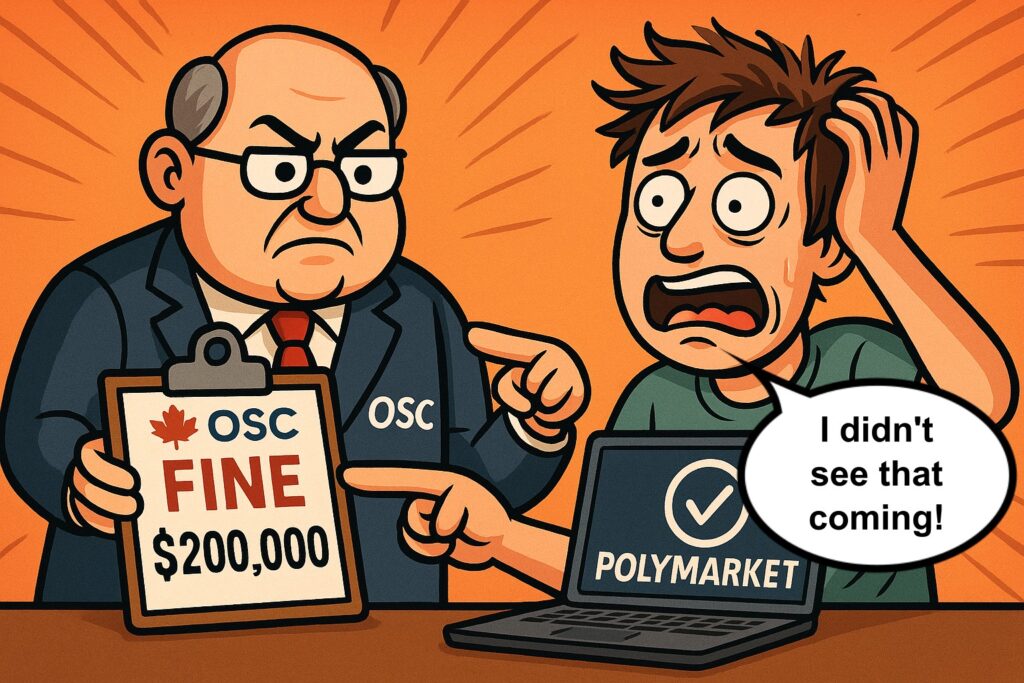
Earlier this year, the Ontario Securities Commission (OSC) levied a CAD $200,000 administrative penalty – plus CA$25,000 in investigation costs and a USD $22,966.75 disgorgement order – against the companies behind Polymarket, the high-profile crypto-prediction platform, ending a months-long enforcement action that reached the province’s Capital Markets Tribunal on April 14 and was approved on April 17, 2025.
In this article, we’ll break down the facts of the Polymarket fine (including explaining what a “binary option” is in the first place), the impact that the penalty could have, additional issues that Polymarket and other prediction markets have faced in other jurisdictions, and why you should care about it in the first place.
The Facts
Polymarket bills itself as a marketplace where users “bet on their beliefs,” buying and selling yes/no shares tied to future events – from election outcomes to macro-economic indicators – using the Polygon blockchain and the USDC stablecoin. Between June 2020 and May 2023, the service listed at least 6,044 separate event contracts that racked up more than USD $254 million in global trading volume, making it one of the most widely known prediction markets around.
Unfortunately for Polymarket, that popularity became a liability in Canada. In 2017, the Canadian Securities Administrators (a coalition of securities regulators from all 10 provinces and 3 territories) introduced Multilateral Instrument 91-102, imposing a hard ban on offering binary options to retail investors across the country. The OSC, as part of this coalition, concluded that Polymarket’s event contracts fell squarely within that prohibition, defining binary options as “a yes/no proposition regarding the future outcome of a price or event… with a term to maturity of less than 30 days.” In the regulator’s view, every click to “buy shares” of “Yes” or “No” was an unregistered derivative trade.
Tribunal filings show roughly 28,500 Ontario-based visitors accessed Polymarket before geoblocking took effect in May 2023. While the operators’ records indicate an Ontario-sourced revenue of only USD $22,966, this was sufficient to trigger enforcement.
The Impact
Under the settlement, Blockratize Inc. (Polymarket’s original U.S. developer) and Adventure One QSS Inc. (its later Panamanian operator) admitted to the statutory breaches and agreed to a two-year province-wide ban on trading. The monetary penalty was paid up-front, alongside the $25,000 costs order and the voluntary disgorgement of Ontario-generated revenue.
Compliance obligations extend well beyond the bill. The companies must keep Ontario residents geoblocked, had to post public notices on their website and social channels within five days of the order, refrain from Ontario-focused marketing, including conference sponsorships, and file anniversary certificates attesting to those controls each year until 2027. Any future plan to re-enter the market will require proactive engagement with the OSC.
The ruling caps a global string of headaches for Polymarket. In January 2022, the U.S. Commodity Futures Trading Commission (CFTC) fined the platform USD $1.4 million and forced it to wind down several markets deemed unregistered event contracts; France has since blocked local access, and regulators elsewhere are scrutinizing the actions of similar sites.
So What?
For Ontario (and Canada as a whole), the case underscores how derivative law, not gambling legislation, remains the sharpest tool against crypto-prediction venues. The administrative penalty is modest in absolute terms but significant relative to the revenue Polymarket earned in the province, and it signals that pleading “small Canadian exposure” will not spare offshore operators from full-scale sanctions.
For traditional gaming companies exploring prediction markets as engagement tools, the lesson is equally clear: these products live in securities law first and gambling law second. Advertising a non-compliant platform – even passively through affiliate links – could expose media partners to scrutiny from securities regulators. Due diligence checklists should therefore include not just iGaming licences but derivative registrations and binary-option prohibitions across all provinces.
Looking ahead, the two-year trading ban and the Tribunal’s explicit invitation to “engage with the Commission” theoretically leaves the door open for a regulated Polymarket 2.0, provided it can satisfy legal, registration, and investor-protection requirements. However, unless the Canadian government changes its perspective on offering binary options, it seems unlikely that there will be space for Polymarket (or other prediction markets) to operate legally in the country.